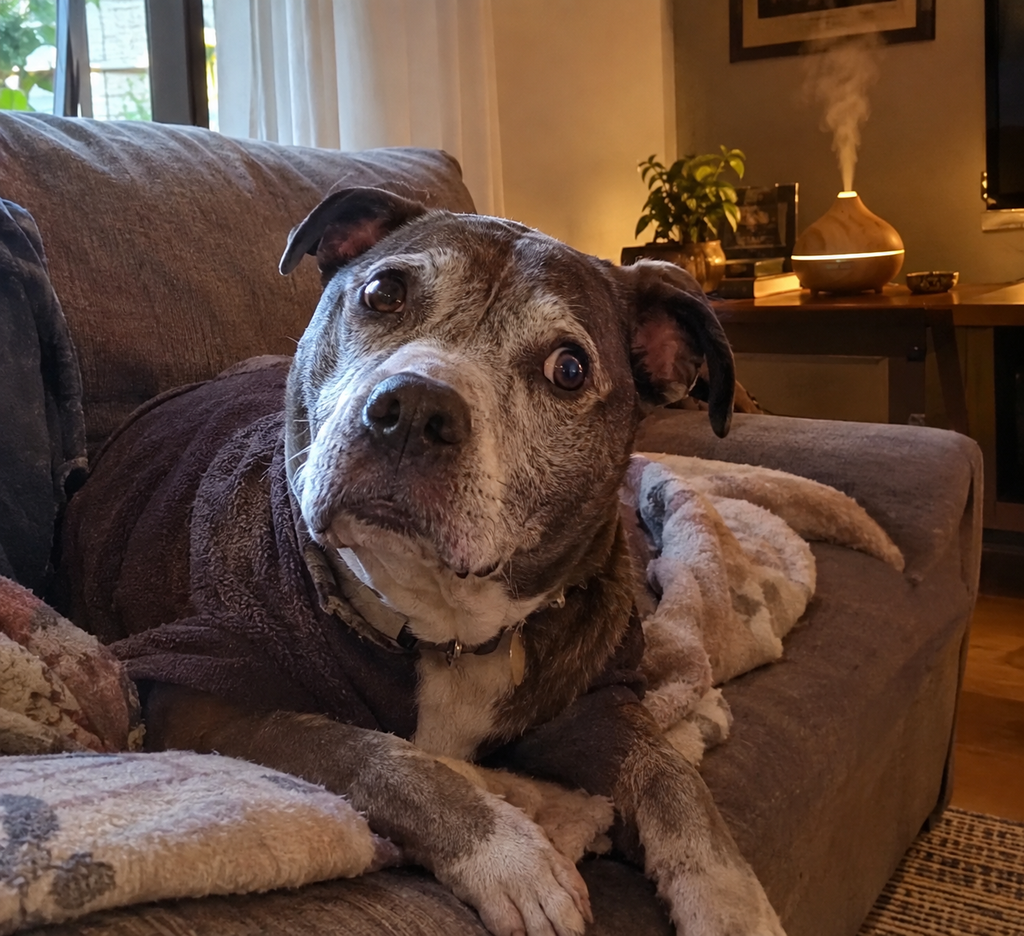
The invisible poison in the air for your senior dog: clearly, they perceive what we don’t even imagine.
When we think about the dangers that exist inside the home, the first thing that comes to mind is food on the floor, open trash, or cleaning products kept in the wrong place. But what about when the danger is invisible, has no color, leaves no dirt, and simply floats through the air? For a senior dog, whose body has already gone through years of natural wear and tear and whose organs (especially the liver and kidneys) work slower, indoor air can hide silent traps.
If you have ever noticed your dog sneezing for no reason, becoming quieter after cleaning, or showing clear discomfort with certain smells, it is worth paying attention. Let’s understand what these toxins in the air are and how to protect his health in old age with simple measures.
What is silent airborne intoxication? Unlike the severe case that happens when a dog eats something poisonous and gets sick right away, airborne intoxication is a silent accumulation. The dog breathes the indoor air all day long. When chemical products in the air or particles of strong smells enter his respiratory system, they pass straight into the blood through the lungs or irritate the airways. In the senior dog, the organism no longer deals well with toxins like before. The liver and kidneys work much harder to filter all of this, which ends up overloading his little body and generating constant fatigue or respiratory problems.
The main sources of invisible poison in indoor air To prevent your pet from suffering from this, it is worth looking at what we use in everyday life:
- Room diffusers and essential oils They make the house smell good, but essential oils (even natural ones) can be toxic to dogs. The problem: Substances from extracts like eucalyptus, lemongrass, or strong lavender are not well metabolized by the dog’s liver. The impact on the senior: Inhaling this directly can cause shortness of breath, weakness, and discomfort.
- Artificial air fresheners and sprays Plug-in devices and aerosols use many chemical compounds for the scent to last. The problem: Since the dog’s sense of smell is super powerful, what is a pleasant smell to us turns into a strong aggression for the senior’s snout and bronchi.
- Smoke from incenses and cigarettes Any smoke generates particles that stay in the air and on the fur. The problem: Incense or cigarette smoke goes deep into the lungs and also accumulates in the carpets, making the dog breathe and lick this later. The impact on the senior: Senior dogs with respiratory problems suffer a lot from coughing fits and shortness of breath.
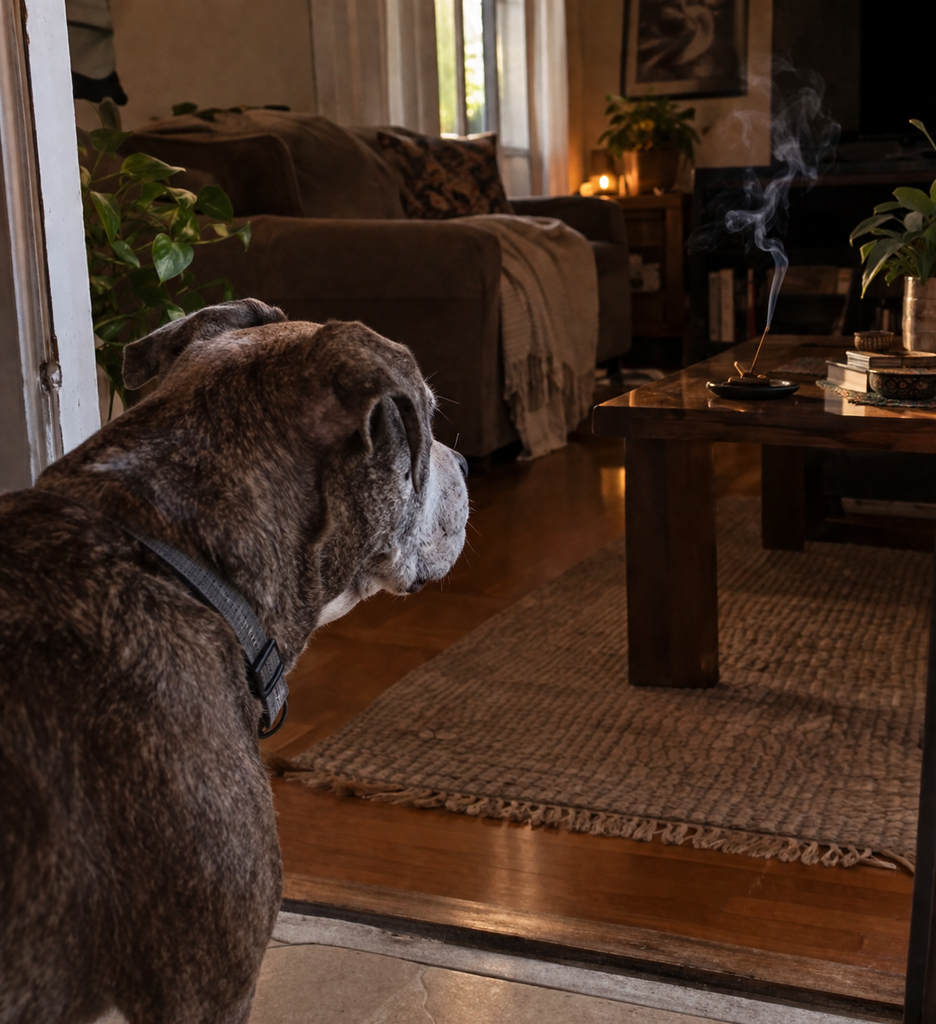
The invisible poison in the air for your senior dog: smoke’s place is never near dogs, much less seniors; respect for his space and sense of smell starts at a distance.
What you can do at home to protect your senior dog? Protecting your companion requires only small habit changes: Get rid of artificial air fresheners: Trade chemical smells for good ventilation, opening the windows to let the air circulate in the morning. Beware of aromatherapy: If you are going to use oils or essences, do it in a room far from the pet and wait for the smell to disappear before letting him enter. Stay away from smoke: If you light incense or smoke, do it in well-separated areas, keeping the senior dog away from the smoke.
👉 For a better understanding of this topic, we recommend reading the article below: https://logicalbark.com/what-are-the-dangers-at-home-for-older-dogs/
A lesson in respect for the senior dog’s sense of smell I’ve always had a lot of respect for this issue at home. I really liked burning incense, but Goe, already in his senior phase, made it very clear that it was uncomfortable for him. It was visible that he didn’t like any smell of that type, just like my cat Snow did too. Because of this, I learned to have common sense: I never left it near him. Whenever I wanted to light an incense, I always tried to do it in the back part of the house, in a suitable and very distant place, never in front of Goe. For a senior dog, respecting his environment and space by guaranteeing clean air is a minimal detail we can give. Their sense of smell deserves to be protected from everything that is invisible to us, but may not be to them.
A lighter breath for the whole home Although the priority is to protect the sensitive sense of smell and respiratory system of the senior dog, ensuring clean air ends up benefiting the entire household. For many pet parents looking to maintain air quality without resorting to chemical artifices or artificial fragrances, investing in mechanical alternatives is the safest path. The use of an air humidifier (used exclusively with pure water, without a single drop of essential oil) helps ease the dryness of the airways — both of animals and humans —, especially in dry weather seasons.
To complement the article, here is an example for awareness: https://amzn.to/46mj9E2
Conclusion: Care that is built every day Although they often seem like trivial situations or details easy to ignore on the daily autopilot, they are not. Small continuous exposures to strong smells, smoke, and substances suspended in the air can, over time, significantly alter the quality of life and health of the senior dog. After all, caring for a senior dog does not boil down to a single isolated emergency gesture; it is a daily construction, based on zeal for all the pillars of well-being during all the years we have the privilege of thriving beside them.
Disclaimer / Legal Notice: This article is for informational purposes only and does not replace consultation with a veterinarian. If your senior dog shows apathy, difficulty breathing, or any strange sign, seek a veterinary clinic immediately.
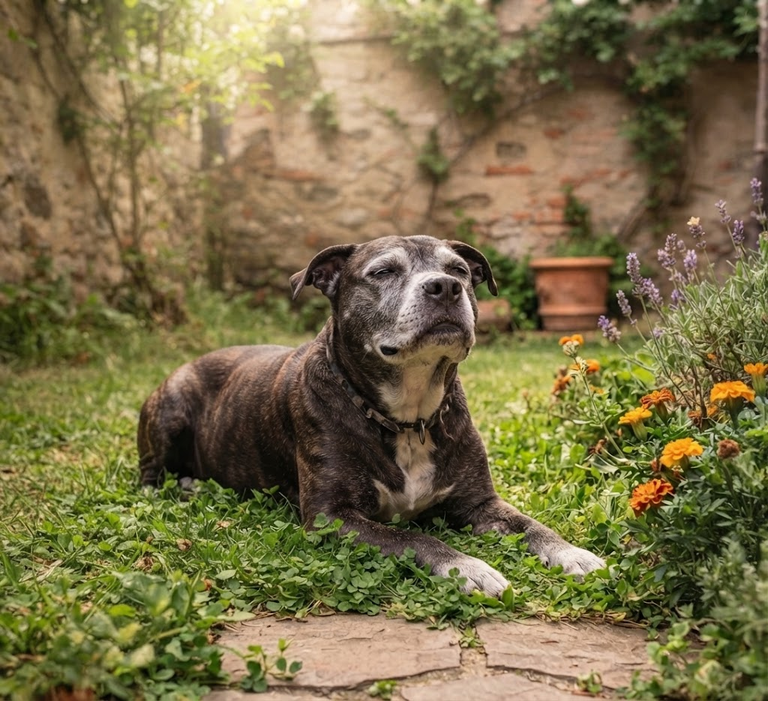
The true care is the pure air that is breathed, the respected space, and the quality of life of the dogs.
You may also like

Lusiane Costa is a digital writer with degrees in Marketing and English Literature.
Creator of Latido Lógico and Logical Bark, she develops evidence-based content on canine aging, wellness, and senior-dog health.
The project was inspired by Goe — a senior dog whose longevity and resilience shaped a grounded, compassionate view on the challenges of aging in pets.
Each article reflects her commitment to transforming real experiences into accessible knowledge, helping owners understand, prevent, and care better for their animals at every stage of life.
Goe remains the heartbeat of this project.