August 15, 2026

When we contemplate the biological complexity of a dog, we are often led to see only their external manifestation: the coat, the expressive gaze, and the gracefulness of their movements. However, contemporary science reveals an infinitely deeper dimension. The canine organism does not inhabit the world in isolation; it is, in itself, a pulsating ecosystem. Far from being merely an individual, a dog is configured as a holobiont — a biological entity integrated by host organisms and an infinity of microscopic beings that co-evolved to make life itself possible.
Within this universe invisible to the eye, billions of microorganisms play structural roles that challenge our traditional concept of physiology. Understanding the essence of terms like microbiota versus microbiome in dogs, what is it, how these concepts differ, and how this impacts longevity becomes a fundamental pillar for any guardian committed to the comprehensive health of their companion.
The Fundamental Distinction: Inhabitants versus the Code of Life
Although frequently used as synonyms in lay literature, the terms microbiota and microbiome refer to distinct yet deeply complementary concepts in intestinal biology.
- Microbiota: Refers to the living population of microorganisms that inhabit a specific ecological niche. In the canine gastrointestinal tract, this encompasses a vast community composed of bacteria, fungi, viruses, and archaea. It is the “resident community” itself.
- Microbiome: A broader, genomic concept. The microbiome includes not only living microorganisms, but their entire genetic inheritance (the combined set of genes of these beings) and the environmental and metabolic elements with which they interact.
To measure this magnitude, it is estimated that the combined genome of a dog’s intestinal microbiota carries roughly 150 times more genes than the host’s own genome. This means that a dog practically operates with two genetic inheritances: its own DNA code inherited from its parents and the vast microbial genetic collection inhabiting its gut. This ecosystem operates with such autonomy and metabolic relevance that many researchers now classify it as a true functional endocrine and immunological organ.
The Hidden Organ: The Gut’s Metabolic Powerhouse
If we were to hypothetically remove this microbial universe from the digestive tract, the dog’s organism would enter an imminent metabolic collapse. The microbiota produces vital substances that the canine metabolism itself is incapable of synthesizing autonomously.
Among these bioactive molecules, short-chain fatty acids (SCFAs) stand out — such as acetate, propionate, and butyrate —, which result from the fermentation of soluble fibers by beneficial bacteria. Butyrate, in particular, acts as the primary energy source for intestinal epithelial cells (enterocytes), strengthening cellular junctions and preventing excessive intestinal permeability. Furthermore, these microscopic beings synthesize essential vitamins, particularly B-complex vitamins and vitamin K, modulate anti-inflammatory mediators, and regulate the cellular absorption of minerals.
The Invisible Bridge: The Gut-Brain Axis
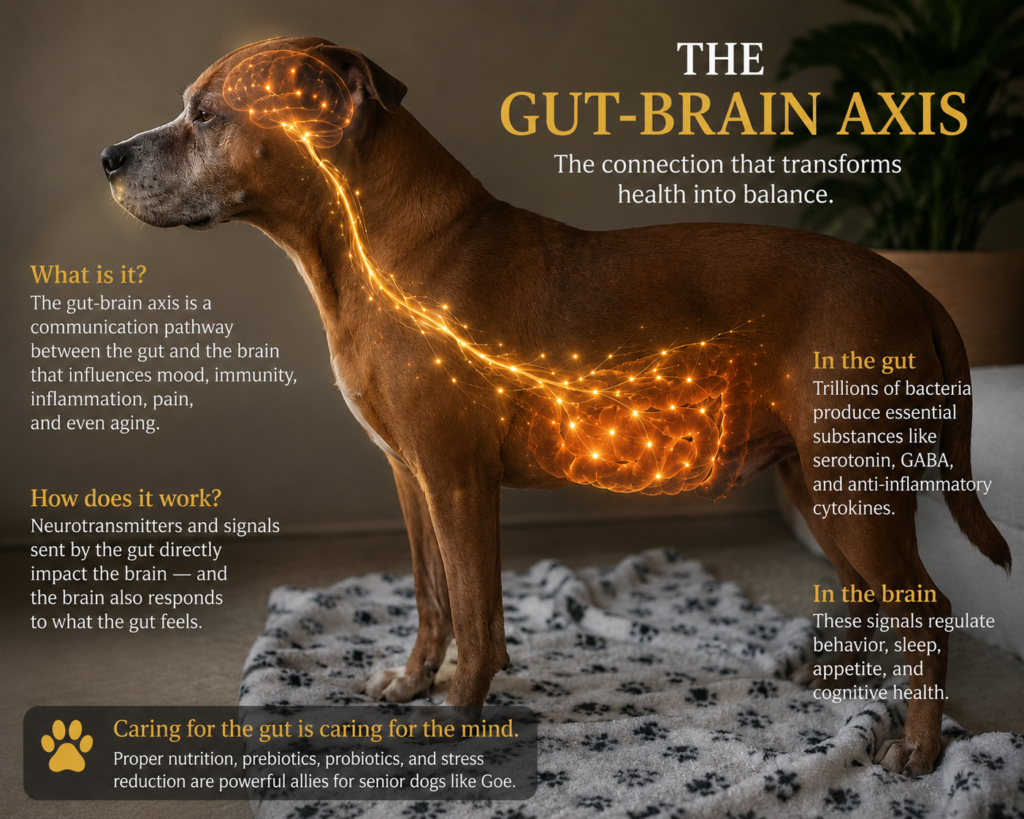
The influence of the microbiota transcends the boundaries of the digestive tract and reaches the dog’s neurological and behavioral sphere. Communication between the gut and the central nervous system occurs through a bidirectional pathway known as the Gut-Brain Axis.
This biochemical highway is primarily mediated by the vagus nerve, as well as by immunological and metabolic pathways. Specific gut bacteria are capable of modulating the production of crucial neurotransmitters:
- Tryptophan and Serotonin: A large portion of serotonin — the neurotransmitter associated with well-being and mood regulation — is produced and modulated in the intestinal environment through the metabolization of tryptophan by the microbiota.
- GABA (Gamma-Aminobutyric Acid): Certain bacterial strains stimulate the production of this inhibitory neurotransmitter, which is essential for alleviating states of anxiety and hyperactivity.
Recent scientific studies demonstrate that dogs subjected to chronic states of fear or environmental stress exhibit a drastic alteration in the composition of their microbiome (dysbiosis). This decrease in microbial diversity reduces protective metabolites and elevates pro-inflammatory cytokines, creating a vicious cycle in which emotional distress degrades gut health, and intestinal imbalance amplifies behavioral reactivity.
👉 Learn more about this topic in the related article below: https://logicalbark.com/canine-aging-begins-in-puppyhood-the-window-of-opportunity-and-the-microbiota/
Educating the Immune System: The Role of GALT
Approximately 70% to 80% of all immune cells in a dog are housed in the gastrointestinal tract, grouped within a specialized structure called GALT (Gut-Associated Lymphoid Tissue). However, GALT is not born fully developed; it must be educated.
It is the microbiota that acts as the primary “instructor” of the immune system. Anatomical structures such as Peyer’s patches, isolated lymphoid follicles, mesenteric lymph nodes, and the lamina propria depend on constant biochemical signals emitted by commensal bacteria.
This immunological pedagogical process occurs in synchronized steps:
- Recognition: Specialized mucosal cells (M cells) capture samples of antigens present in the intestinal lumen.
- Presentation and Learning: Dendritic cells process these fragments and present them to lymphocytes, signaling whether that structure belongs to an allied bacterium (which must be tolerated) or a pathogenic agent (which must be fought).
- Modulated Response: Activated B lymphocytes begin secreting Secretory Immunoglobulin A (sIgA), a vital antibody that coats the intestinal mucosa, neutralizing harmful microorganisms without triggering destructive inflammatory reactions.
Without this proper training provided by a diverse microbiota, the immune system can become hyperactive, reacting against harmless food proteins or the body’s own tissues — the genesis of many atopic dermatitis cases and autoimmune diseases.
The First Weeks of Life: The Foundation of a Biological Journey
The architecture of this internal ecosystem is not a matter of chance; it begins to take shape in the earliest moments of an individual’s existence. A puppy’s first weeks of life represent a critical and irreversible window for microbial colonization and the development of immunological maturity.
In Goe’s case, his biological trajectory benefitted from extremely favorable foundations. Born via natural birth into a litter of nine siblings from Pitbull parents, his initial experience shaped his resilience. Natural birth provides the first and most vital “bath” of beneficial bacteria originating from the maternal reproductive and intestinal tracts. Subsequently, nursing and constant physical contact with his mother and littermates ensured a continuous transfer of complex milk oligosaccharides — molecules that do not directly nourish the puppy, but serve as exclusive food for the proliferation of beneficial bacteria within his pristine gut.
Understanding the dynamics of microbiota versus microbiome in dogs, what is it, how this living web operates, and how it is seeded in infancy gives us the clarity that every dietary choice, the conscious use of antibiotics, and stress management throughout adult life are direct acts of preservation for this vital ecosystem.
⚠️ IMPORTANT DISCLAIMER
This content is strictly educational and informational in nature. Understanding the canine microbiota and microbiome aims to enrich a guardian’s knowledge regarding their companion’s physiology, and does not replace professional diagnosis, prescription, or guidance from a veterinarian. In the presence of any gastrointestinal, dermatological, or behavioral symptoms, always consult a qualified professional.
You may also like

Lusiane Costa is a digital writer with degrees in Marketing and English Literature.
Creator of Latido Lógico and Logical Bark, she develops evidence-based content on canine aging, wellness, and senior-dog health.
The project was inspired by Goe — a senior dog whose longevity and resilience shaped a grounded, compassionate view on the challenges of aging in pets.
Each article reflects her commitment to transforming real experiences into accessible knowledge, helping owners understand, prevent, and care better for their animals at every stage of life.
Goe remains the heartbeat of this project.