Have you ever wondered what your dog thinks when they see you spending several minutes looking at a device, and how your dog understands this context?
For us, the answer seems obvious. Cell phones are present in practically every moment of modern life: we use them to work, talk, study, research, solve problems, and also to rest. But there is a detail we often forget: dogs do not know the meaning we give to this object.
They don’t know we are answering an important message. They don’t understand that screen represents work, commitments, or responsibilities. They simply observe their guardian’s behavior and try to interpret it based on experiences that make sense within their own world.
And that is precisely where an interesting reflection begins about coexistence, well-being, and canine aging.
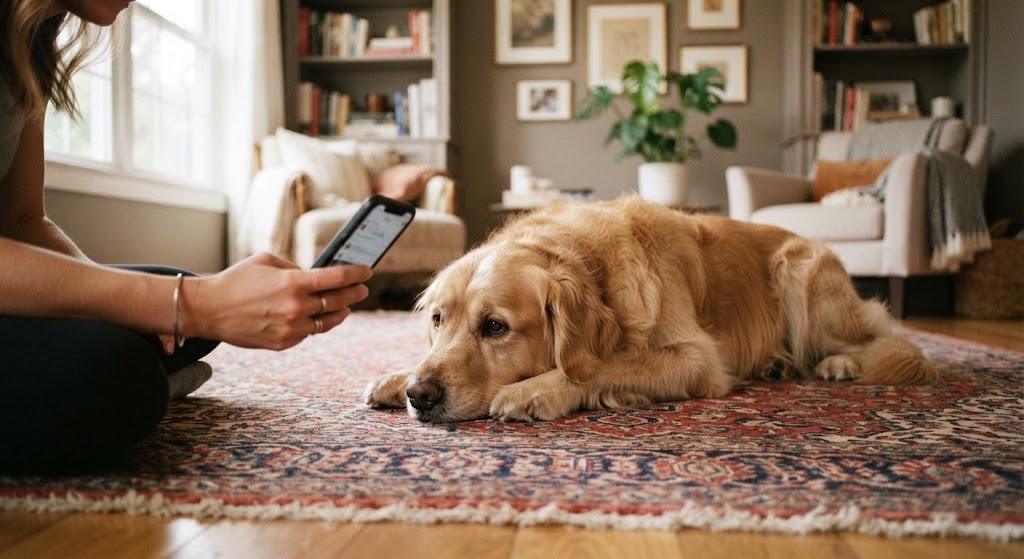
How your dog understands your cell phone: an invisible barrier that drains your focus and leaves their affection waiting in the void
There is nothing wrong with using a cell phone near your dog. Nor would it be realistic to imagine that a guardian needs to remain available to the animal every single hour of the day.
Dogs sleep, rest, observe their environment, and naturally go through periods of low activity.
The issue is another: what happens when a very large portion of the dog’s routine is marked by a lack of opportunities to interact, explore, and participate in the environment?
Imagine a dog looking at their guardian for several minutes. The guardian is sitting, concentrated on the screen, and seemingly wrapped up in something very important. The dog has no way of knowing what is happening on that device.
To them, there is simply a familiar person right there, but whose attention is temporarily unavailable.
It is a small difference to us, but huge when we think from the animal’s perspective.
Dogs don’t experience time like we do
Another important point is that dogs do not organize life using the same human concepts.
We are able to think: “I’ll finish this now and then I’ll pay attention to my dog.” We can look at the clock, establish priorities, and understand that a certain activity will last twenty or thirty minutes.
Dogs do not plan this way.
They perceive events, routines, smells, sounds, movements, and associations. They learn that certain actions precede others and recognize everyday patterns, but they do not need to understand our justification to realize that something has changed.
Therefore, when a guardian spends a lot of time engaged with a cell phone or computer, the dog may simply experience that period as yet another moment of little interaction.
The brain also needs experiences
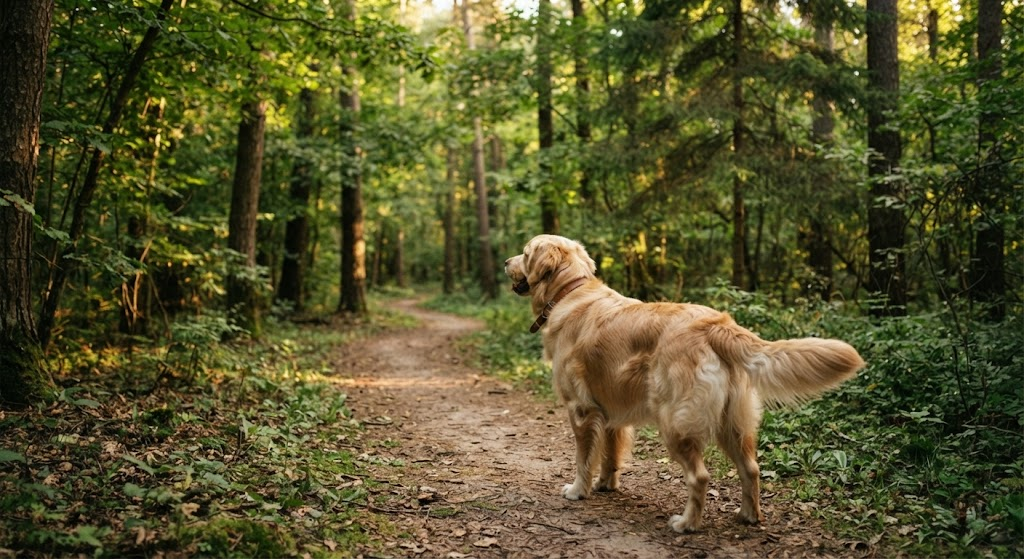
Outdoor exploration is a genuine cognitive stimulus that awakens your dog’s natural instincts, promoting balance and healthy aging.
When we think about care for senior dogs, it is common to concentrate our attention on diet, medical exams, mobility, and veterinary monitoring.
All of this is fundamental.
But there is another dimension of aging that deserves space: the need to offer the brain adequate opportunities to keep functioning and receiving information.
Aging does not mean a dog needs to be constantly entertained. Quite the contrary. Rest remains important and must be part of a balanced routine.
However, a completely predictable life, without opportunities for investigation, learning, and interaction, can offer very few stimuli for an animal that still possesses the capacity to explore the environment.
Caring for longevity also means giving the brain reasons to keep participating in life.
Enrichment is not synonymous with a new toy
When people talk about environmental enrichment, many immediately think of toys, activity mats, and objects sold specifically for dogs.
And those can be useful.
But enrichment is a much broader concept.
A dog can be stimulated when they have the opportunity to sniff during a walk, search for hidden food, investigate a different location, learn a new behavior, or choose between possibilities within a safe situation.
Even a simple change in routine can spark interest.
A walk where the dog can stop and sniff different spots, for example, can be a much richer experience than simply covering a distance quickly.
Likewise, an extremely sophisticated toy can lose its novelty when it stays in the exact same place for months without any variation.
Enriching a dog’s life is not keeping them busy all the time. It is providing experiences that have some meaning to them.
👉 If you wish to expand your knowledge on this subject, check out this complementary content: https://logicalbark.com/what-is-vitamin-d-vitamin-dirt-for-senior-dogs-and-how-to-treat-your-senior-dog/
And there is a type of enrichment that costs nothing
There is also a form of enrichment that does not need to be purchased.
It is the guardian’s participation.
Talking to your dog, teaching them something simple, playing for a few minutes, allowing them to explore an environment, or simply being present during an activity can be part of this experience.
It is not necessary to turn every moment into a training session.
Sometimes, five minutes of true attention can be more interesting to a dog than a large number of objects scattered around the house.
What I noticed with Goe
This reflection also arose, in part, from my own coexistence with Goe.
When I was working, I often noticed that he would stay right nearby, standing still, while my attention was concentrated on the computer or cell phone.
To me, that had a very clear explanation. I was working. There was a task to finish, something that needed to be resolved, and a concrete reason for me to remain focused.
But Goe had no way to understand this explanation.
He didn’t know I needed to finish a certain activity. He didn’t know that screen represented work. He didn’t have access to the context that justified my lack of attention at that moment.
This experience made me think about a question I consider essential in the relationship between people and dogs: how much of what we believe to be obvious to us actually makes sense to them?
There is a distance between human needs and canine needs
Perhaps there is a wide gap between what the guardian understands as an adequate routine and what the dog actually experiences.
We organize the house, the schedule, work, commitments, and rest moments according to human needs.
The dog participates in this routine, but they do not start seeing the world as a person.
They remain a dog with their own needs, their own forms of communication, and a different way of experiencing the environment.
Therefore, understanding a dog requires a small exercise in perspective-shifting.
Instead of only asking “what do I think they need?”, we can start asking: “what opportunities are they having to do, perceive, investigate, and learn?”
We don’t need to abandon our cell phones
The goal of this reflection is not to turn the cell phone into a villain.
It is part of our lives and, for many people, it is also part of work. It would be impossible and even unnecessary to try to eliminate it from our routine.
What we can do is create small spaces for effective conduct.
At certain moments, put the cell phone aside and pay exclusive attention to your dog. Take a walk without rushing. Allow them to sniff. Teach something new. Hide a few treats for them to search for. Change a familiar activity.
For senior dogs, these experiences must respect their physical conditions, their pace, and their limitations. Enrichment should not be a competition or an obligation.
The goal is to offer opportunities compatible with that individual.
Perhaps they are just waiting for you to notice
Next time you pick up your cell phone, try looking at your dog before going back to the screen.
Maybe they are sleeping deeply and don’t want anything at all.
Maybe they are observing you.
Maybe they want to go out, play, investigate a smell, or simply stay close.
We don’t need to respond to all these needs immediately. But noticing them already changes the quality of the relationship.
Because the cell phone may be an indispensable tool for us, but to the dog, it is simply an object that sometimes seems to receive an overwhelming amount of their guardian’s attention.
And perhaps this is the true question behind How your dog understands your cell phone:
it’s not about what exists on that screen, but about what the dog stops experiencing while we are looking at it.
Caring for a dog’s longevity is also caring for the quality of their days. It doesn’t mean filling every minute with activities, but offering rest, security, interaction, movement, and opportunities for that brain to keep finding small reasons to explore the world.
And sometimes, an entire life fits into the exact instant when the screen goes dark and we finally lift our eyes to find who has been by our side the whole time, waiting just for a meeting of glances to give true meaning to the now.
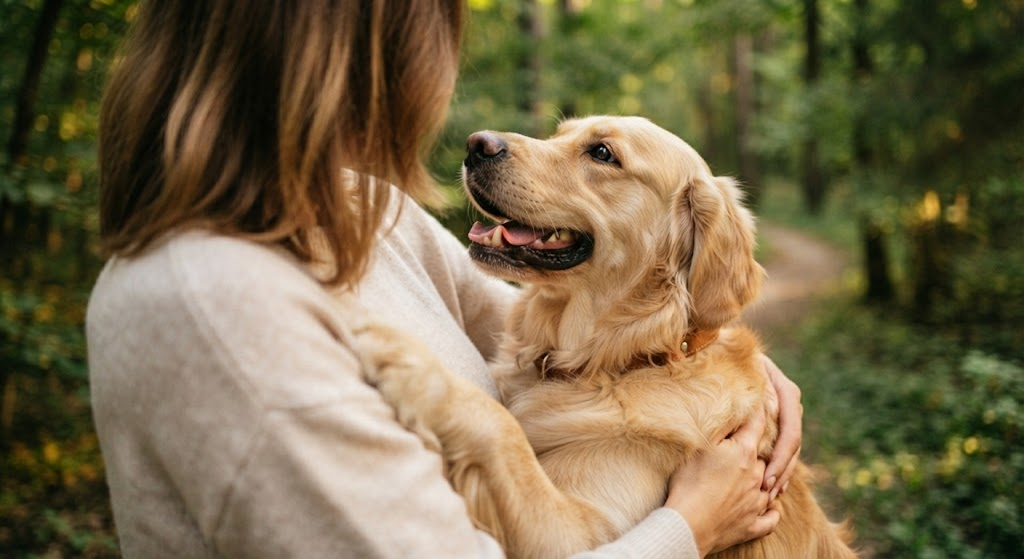
This image no screen can replicate.
You may also like

Lusiane Costa is a digital writer with degrees in Marketing and English Literature.
Creator of Latido Lógico and Logical Bark, she develops evidence-based content on canine aging, wellness, and senior-dog health.
The project was inspired by Goe — a senior dog whose longevity and resilience shaped a grounded, compassionate view on the challenges of aging in pets.
Each article reflects her commitment to transforming real experiences into accessible knowledge, helping owners understand, prevent, and care better for their animals at every stage of life.
Goe remains the heartbeat of this project.