
October 14, 2026
Have you ever stopped to observe which paw your dog uses first when asking for affection, trying to reach an object, or holding a bone on the floor? For many owners, the idea that dogs have a preferred side might sound like news, but science has already proven it: just like human beings, animals can also show a preference for one side of their body. Over the years and with the arrival of pet seniority, understanding your companion’s laterality becomes even more essential. But after all, how to know if your senior dog is left-handed? What does this characteristic reveal about your old friend’s behavior, sensitivity, and routine? In this complete guide, we will explain everything about canine laterality, how to perform tests at home, and what care to offer in the senior phase.
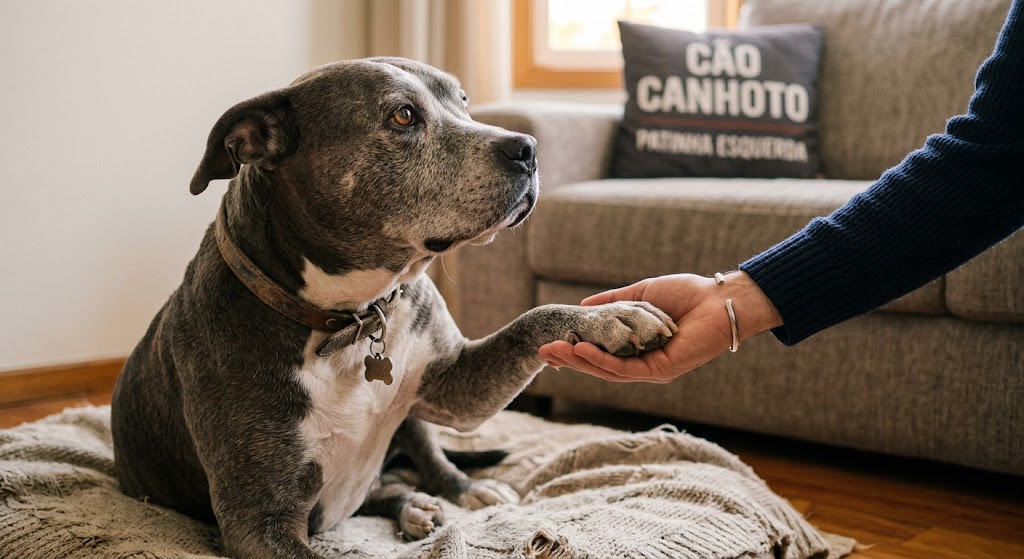
If he offers you his left paw frequently, this is a strong indication of how to know if your senior dog is left-handed and better understand your friend’s sensitivity.
Can animals be left-handed? The answer is a definitive yes. Animals can be left-handed, right-handed, or ambidextrous. However, there is a big difference between dogs and humans when it comes to statistics. While the vast majority of the human population is right-handed (about 90%), in dogs the distribution is much more balanced. Research in the field of neuroscience and veterinary behavior points out that the division between right-handed, left-handed, and dogs with no defined preference (ambidextrous) is divided almost equally, ranging between 30% and 40% for each group. Lateral preference reflects the function and dominance of the animal’s brain hemispheres:
- Left hemisphere: Controls the right side of the body and is associated with processing routines, positive emotions, and feelings of calm.
- Right hemisphere: Controls the left side of the body (left-handed dogs) and is linked to processing intense emotions, caution, fear, and alertness responses. For this reason, deeply understanding how to know if your senior dog is left-handed helps decipher not only how he moves, but also how he reacts to the environment and the challenges of aging.
Practical tests to discover your dog’s preference Discovering if your dog is left-handed does not require complex exams. You can perform simple tests at home. The secret is to repeat each exercise 10 to 20 times over a few days to get a reliable sample, always observing which paw he uses first.
- The Toy Test Get an interactive rubber toy (like a Kong) and fill it with a tasty paste, wet food, or treats. Place the toy on the floor, centered right in front of the dog.
- Which paw does he use first to support, hold, or stabilize the toy while trying to lick the food out?
- If he predominantly uses his left paw, there is a strong indication that he is left-handed. To complement the article, here is a widely used option by pet owners:
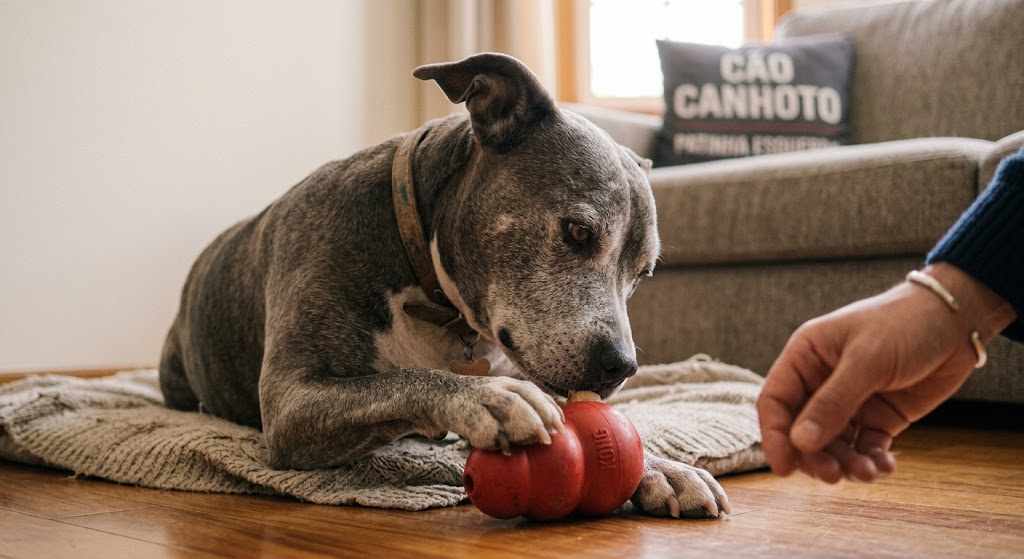
Observing which paw he uses to hold the Kong is the first step of how to know if your senior dog is left-handed!
Here is a practical example widely used by pet owners: https://amzn.to/4e8Bqc6
- The Reach Test Choose a low piece of furniture in the house, such as a sofa, bed, or armchair. Place a treat slightly under the furniture, at a distance where the dog can see and smell it, but needs to stretch out a paw to pull it out.
- Position the dog facing the furniture.
- Observe which paw he stretches out first to try to reach the food.
- Repeat the test a few times to see if the preference remains consistent.
- The Closed Hand Test This is one of the easiest and fastest tests to apply in daily life:
- Close your hand with a very tasty treat inside.
- Position your closed hand at the dog’s snout height, right in the center.
- The dog will smell and try to use one of his paws to “ask” or attempt to open your fingers.
- The paw he raises first most frequently indicates motor dominance.
Behavior, sensitivity, and gender trends Lateral preference in dogs brings along a series of striking behavioral and physiological characteristics.
Gender trend Science has identified that there is an important hormonal influence on canine laterality:
- Males: Show a significantly higher statistical tendency to be left-handed.
- Females: Tend more frequently to show a preference for the right paw (right-handed).
Are left-handed animals more sensitive? Yes. Since the use of the left paw is directly connected to the brain’s right hemisphere — responsible for processing stress, fear, and self-preservation reactions —, left-handed dogs usually display a more reactive and sensitive emotional profile. It is common to observe in left-handed dogs:
- Greater sensitivity and fear of loud noises (fireworks, thunder, or renovations).
- Greater caution and hesitation in the presence of strangers or in unfamiliar environments.
- A tendency to show anxiety in situations outside their routine.
What to notice in senior left-handed dogs? With advancing age, the dog’s innate brain preference does not change, but his body and behavior undergo significant transformations. If you have already applied the tests or suspect that your senior furry friend is left-handed, pay attention to these factors:
- Changes in paw use and signs of pain If a dog that has always used his left paw for everything suddenly starts using his right paw for the reach test or to interact, be very attentive. In old age, sudden changes in motor preference usually do not indicate a neurological change, but rather joint pain or discomfort (such as arthrosis, arthritis, or dysplasia) in the preferred paw. He starts using the other paw to compensate for the pain.
- Increased sensitivity and insecurity As dogs age, it is natural for a certain sensory decline to occur, such as gradual loss of vision and hearing. For a senior left-handed dog — who already possesses a naturally more sensitive profile —, this sensory loss can increase nighttime anxiety and the fear of being left alone.
The ideal routine and needs for a senior left-handed dog To ensure the well-being and quality of life of your companion in old age, it is necessary to adapt daily care considering his physical and psychological needs:
Maintaining a structured and predictable routine Sensitive senior dogs benefit immensely from consistency. Keep feeding, walking, and resting times fixed. Avoid abrupt changes in the arrangement of furniture around the house, as environment predictability drastically reduces the senior pet’s stress.
Comfort and mobility adaptations
- Non-slip floors: Scatter rugs or runners around the house to prevent the senior dog from slipping and straining his joints when getting up.
- Orthopedic beds: Soft accommodations with good support help relieve pressure on worn-out joints.
- Gentle walks and calm environmental enrichment: Swap long walks for short, frequent ones, allowing him to sniff the environment without rushing. Gentle sniffing games with stuffed toy tests are excellent for keeping the senior dog’s brain active.
👉 This subject is also related to the content we present in this article: https://logicalbark.com/what-is-vitamin-d-vitamin-dirt-for-senior-dogs-and-how-to-treat-your-senior-dog/
Conclusion Knowing how to know if your senior dog is left-handed goes far beyond simple curiosity about your pet. It is a valuable tool to better understand your faithful friend’s personality, emotional reactions, and health status during old age. By performing the toy, reach, and closed hand tests, and by closely observing your senior dog’s routine, attitudes, and any potential signs of pain or sensitivity, you guarantee him a comfortable, safe, and affection-filled life in his golden years. After all, these are accounts of care routines that require a human perspective that automatic responses cannot replicate.
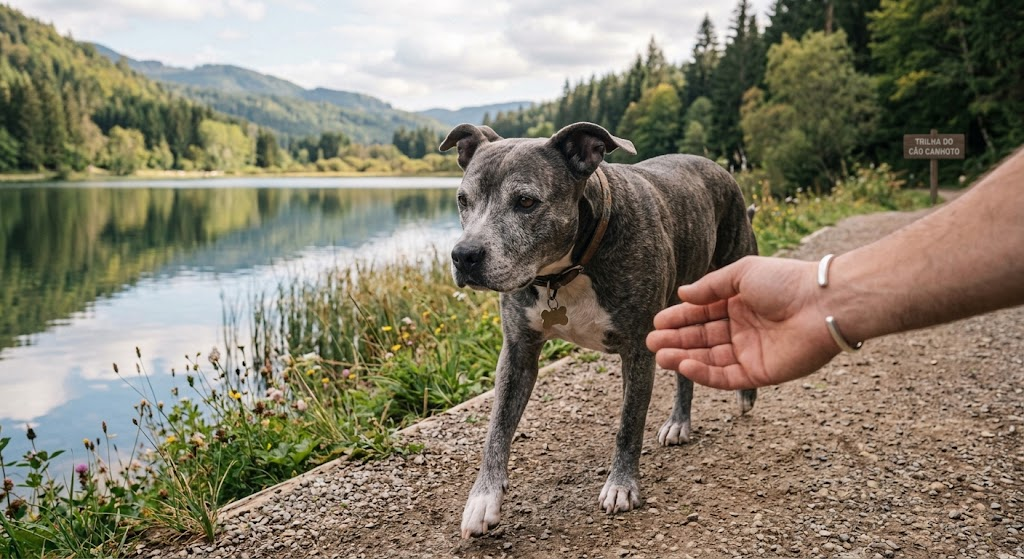
Walking together and respecting your friend’s pace is essential. Discovering how to know if your senior dog is left-handed helps to better understand his sensitivity and make every walk even more enjoyable.
Youm may also like

Lusiane Costa is a digital writer with degrees in Marketing and English Literature.
Creator of Latido Lógico and Logical Bark, she develops evidence-based content on canine aging, wellness, and senior-dog health.
The project was inspired by Goe — a senior dog whose longevity and resilience shaped a grounded, compassionate view on the challenges of aging in pets.
Each article reflects her commitment to transforming real experiences into accessible knowledge, helping owners understand, prevent, and care better for their animals at every stage of life.
Goe remains the heartbeat of this project.