
August 3, 2026
Have you ever noticed how your dog seems to have an “invisible clock” in their brain? Whether it’s the exact time for a walk, the moment food should hit the bowl, or that punctual wait by the door when you’re about to arrive, their accuracy is impressive.
But can they really read a clock or understand the difference between 5 minutes and 2 hours? Understanding how senior dogs know the time involves a fascinating combination of neuroscience, olfactory sensitivity, biological rhythms, and the power of routine.
1. They Don’t Read Minutes, But They Distinguish “Short” from “Long” Periods of Time
For us humans, time is measured by hands, numbers, and stopwatches. For dogs, temporal awareness operates on a different frequency. Although they don’t understand the exact metric of minutes, canine cognition research shows that dogs clearly distinguish short periods of absence from long waits. If you leave for 15 minutes to run a quick errand or pick up bread, your dog’s emotional and behavioral response upon your return is quite different from when you spend the entire day away at work.
2. The Neuroscience Behind Perception: “Time Neurons”
The explanation for how dogs identify the passage of time isn’t mystical; it’s neurobiological. Discoveries in the field of animal neuroscience revealed that mammalian brains harbor populations of nerve cells in the hippocampus known as time neurons.
Instead of counting seconds, these neurons fire in a sequential pattern. They trigger a chain reaction, creating a true neural timeline. This activity allows the animal’s brain to log the duration of events and organize memories in chronological order. It is this neurological representation that tells a senior dog that one phase has ended and the next event in their routine is about to happen.
3. The Olfactory Trail: Time Measured by the House’s Scent
In addition to the internal brain mechanism, a dog’s sense of smell works as an environmental timer. When you are home, your skin and clothes release a very high concentration of scent particles into the air.
As soon as you walk out the door, the concentration of your scent in the room gradually fades. A dog’s brain learns to map the passage of time through the decreasing intensity of your scent. When the residual odor reaches a specific level of decay—that exact point their memory has linked to your return—the animal knows it’s time to watch the door.
4. Reading Environmental Sequences
Dogs are masters at connecting environmental cues to build their own daily “calendar.” They don’t track numerical hours, but they absorb a chained sequence of events:
- The sunlight shifting position and hitting a specific spot in the living room or kitchen.
- The distinct sound of a delivery truck passing by at a certain time of day.
- The movement of neighbors and street traffic in the late afternoon.
- The dropping temperature and fading daylight.
5. Biological Clocks and How Goe, My Senior Dog, Read the Environment
Working alongside scent and environmental cues is the circadian rhythm—the internal biological clock that regulates hunger, body temperature, and sleep-wake cycles. As dogs age, these rhythms become even more deeply ingrained.
Science explains the mechanism, but it was in our daily life together that I witnessed this in a unique way with my beloved senior dog, Goe. Goe had an incredible perception of routine. On mornings when he stayed outside early on, he never needed an alarm. At 6:00 AM sharp—the exact time I used to wake up—there he was, waiting right in front of the window for my very first movement.

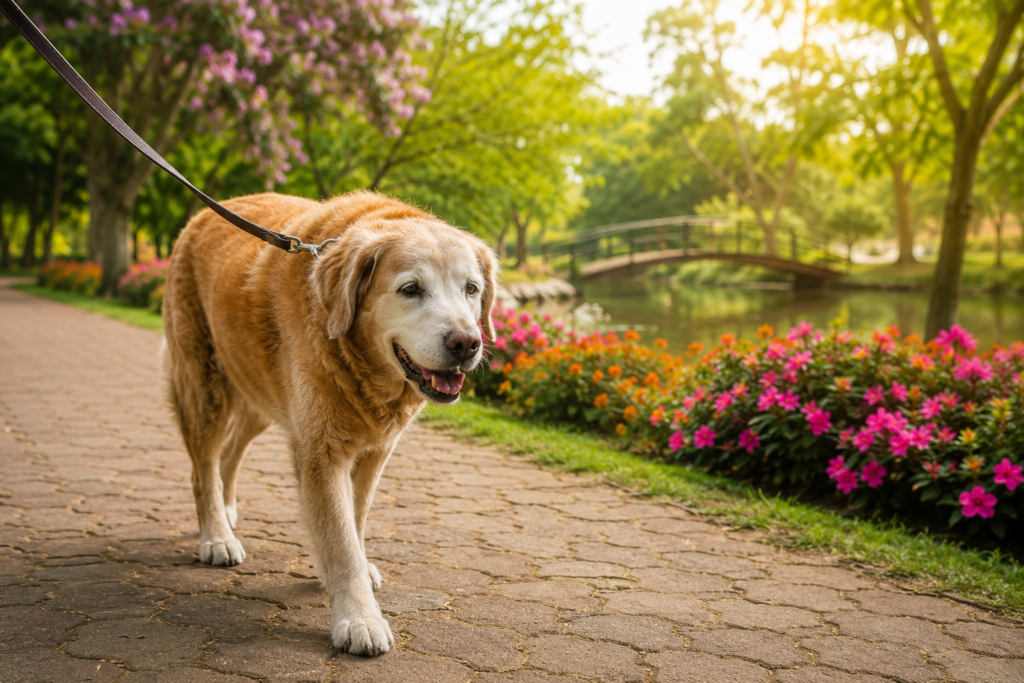
Even from the outside, Goe knew precisely when I was waking up. He bridged the dawn’s light, the faint sounds of the house stirring, and his internal biological clock to know that a new day was starting and that it was time for us to greet each other. More than just waiting at the window, this photo of Goe is living proof of how senior dogs know the time. Time for them isn’t measured in minutes, but in longing and the certainty that we will come back.
6. The Impact on the Senior Brain: How Uncertainty Fuels Anxiety
If lack of predictability creates discomfort for a young dog, for a senior dog, unpredictability takes an even heavier toll. The senior brain craves stability; constant uncertainty regarding schedules keeps them in a continuous state of high alert that feeds separation anxiety.
💡 Practical Olfactory Management Tip:
If you need to leave and want to lower your dog’s anxiety, offer a stuffed treat toy with a tasty reward right at the moment you step out. This strategy shifts the animal’s olfactory and cognitive focus toward a positive, calming activity, reducing departure stress and helping modulate their perception of wait time.
👉 If you’d like to dive deeper into this topic, check out this complementary article: https://logicalbark.com/separation-anxiety-in-dogs-causes-and-effective-strategies/
7. Conclusion: The Importance of Routine for Senior Dog Health and Longevity
Understanding how senior dogs know the time shows us that routine isn’t just a habit for them: it’s a biological necessity and a pillar of preventive health care.
Studies in veterinary behavior and physiology indicate that chronic unpredictability keeps cortisol (the stress hormone) levels constantly elevated. This state brings serious consequences for senior dogs:
- Immune System Suppression: leaving the body more vulnerable to infections and illness.
- Low-Grade Chronic Inflammation: accelerating joint wear and cellular aging.
- Sleep Disturbance: making deep rest and neurological recovery difficult.
Behavioral studies (such as Dreschel, 2010) reinforce that prolonged states of anxiety and fear are directly tied to a shorter lifespan in dogs. Therefore, maintaining predictable schedules for feeding, walks, and rest is the deepest form of love—providing peace of mind, biological balance, and longevity to your old companion.
To ease the waiting period, some owners opt for highly-rated enrichment toys while away from home. If you’re interested, I’ll leave an example here for you to check out: https://logicalbark.com/separation-anxiety-in-dogs-causes-and-effective-strategies/

Canine perception transfigures the hours: time for them is not counted by the clock, but measured in the depth of feeling and in the architecture of waiting.
Legal Disclaimer:
This content is strictly for educational, informational, and preventive purposes, based on animal cognition literature and practical handling reports. It does not replace consultation or follow-up with a veterinarian or animal behavior specialist. If your senior dog shows sudden behavioral changes, disorientation, or severe anxiety, seek professional guidance.
You may also like

Lusiane Costa is a digital writer with degrees in Marketing and English Literature.
Creator of Latido Lógico and Logical Bark, she develops evidence-based content on canine aging, wellness, and senior-dog health.
The project was inspired by Goe — a senior dog whose longevity and resilience shaped a grounded, compassionate view on the challenges of aging in pets.
Each article reflects her commitment to transforming real experiences into accessible knowledge, helping owners understand, prevent, and care better for their animals at every stage of life.
Goe remains the heartbeat of this project.