
April 28, 2026
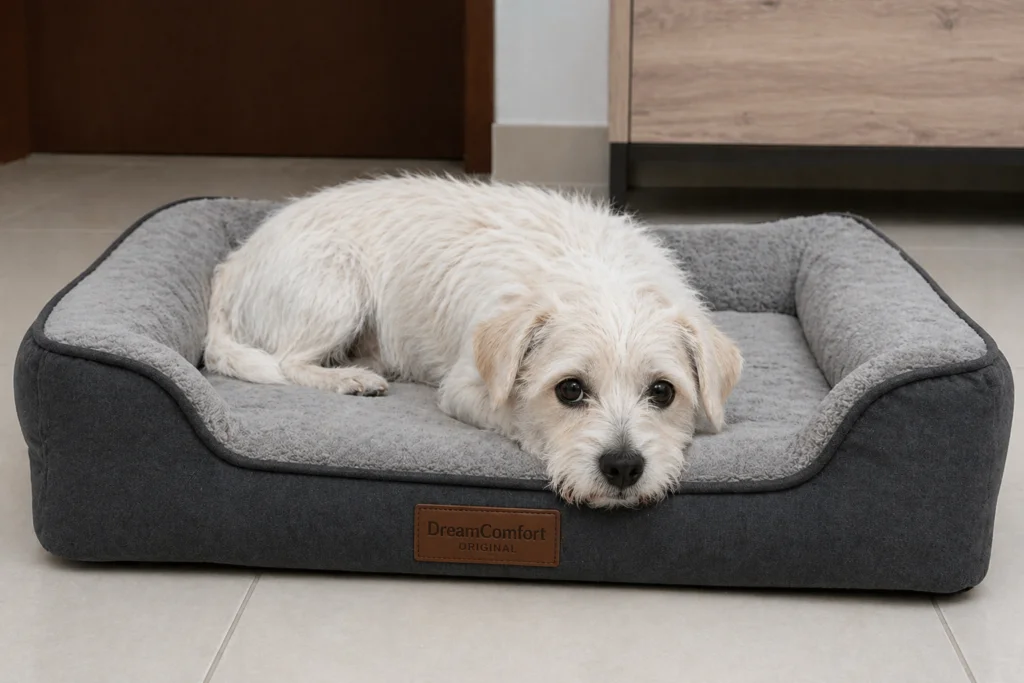
A look that may reveal a context of behaviors linked to separation anxiety in dogs.
Separation anxiety in dogs is a behavior that may appear when a dog suffers intensely in the absence of their guardian. For many dogs, being alone is not simply a matter of waiting for someone to return. It can become an experience of insecurity, agitation, and emotional distress.
Some signs often draw attention: the dog follows the guardian throughout the house, becomes restless when noticing that someone is about to leave, barks, howls, cries near the door, destroys objects, pants, walks back and forth, or even refuses food. In some cases, the behavior appears even before the person leaves, when the dog notices repeated routine movements such as picking up a bag or opening the door.
Why Does Separation Anxiety Happen?
Separation anxiety may be related to different factors. Some dogs were not gradually accustomed to being alone. Others have gone through environmental changes, loss of companionship, the arrival of a new animal, abrupt routine changes, or stressful experiences. The central point is understanding that the dog is not merely reacting. They may be expressing emotional distress through behavior.
For this reason, the guardian’s response should be balanced and conscious. Impulsive reactions or displays of irritation often increase insecurity and make the dog’s adaptation more difficult.
Turn Departure Into a More Positive Experience
An effective and interesting strategy is to change the way food is offered when the guardian needs to leave. Instead of placing kibble only in the bowl, food can be distributed in interactive toys, treat-dispensing balls, or enrichment mats.
This change helps the dog associate the guardian’s departure with a positive activity. The dog begins to sniff, search, push, lick, explore, and work mentally to access the food. This does not solve every case of anxiety, but it can make the moment less tense and more engaging.
Environmental enrichment is important because many dogs become anxious not only due to the guardian’s absence, but also because of a lack of stimulation. An empty environment, one that is too predictable and without activities, may increase restlessness. When the dog receives an appropriate challenge, their energy is directed toward a task.
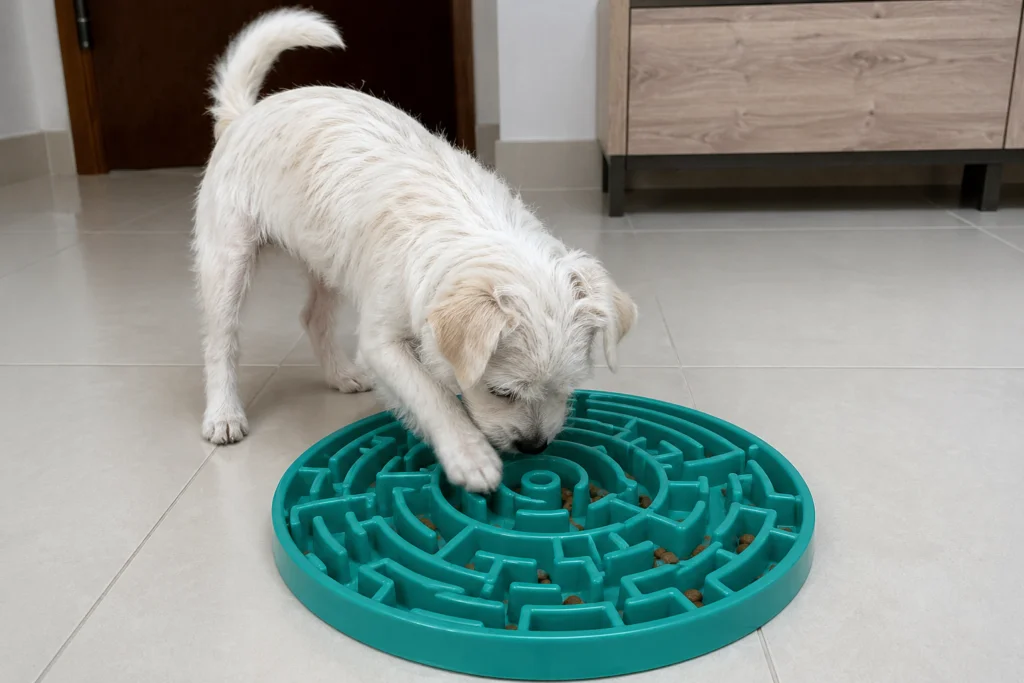
Dog engaged with an enrichment mat, feeling calmer even while away from the guardian.
Do Not Offer Everything in the Bowl at Once
A good option is not to leave the food in the bowl when going out, but instead separate it into enrichment activities. The guardian can portion some of the food and place it in dog-safe toys, respecting the dog’s size, bite strength, and safety level.
Over time, the dog begins to understand that this moment has a sequence: the guardian leaves, but first provides an interesting activity. This predictability can be very helpful. For the dog, routine works as a kind of emotional organization.
Snuffle mats can also be useful. They stimulate the sense of smell, slow down feeding, and offer a longer-lasting task. For dogs that eat too quickly or become agitated before departure, this type of resource may contribute to a calmer transition.
If you would like to explore practical examples and helpful options, it may be worth considering alternatives that can support this routine.
Here are some options well-rated by guardians → https://amzn.to/4t7MOtB
There is also a more robust option: an interactive mat with a larger surface area and different challenge levels, designed to increase exploration time and engagement: https://amzn.to/4dcr6zK
Practice Short Absences
Another important point is not to wait for a long absence to begin training. Ideally, short absences should be practiced during the day. The guardian can leave for a few minutes, return calmly, and repeat this process at other times.
The goal is to show the dog that leaving and returning are part of normal life. Very intense goodbyes and overly euphoric returns may reinforce the idea that separation is a dramatic event. More natural departures and arrivals help reduce emotional tension.
Do Not Reinforce Return Excitement
When arriving home, avoid turning the reunion into an excessively intense moment. Overly euphoric responses may reinforce exaggerated expectations surrounding your departure and return, maintaining the cycle of anxiety. Calmer and more natural greetings tend to support greater emotional balance in the dog.
Observe Your Dog’s Signals
Each dog reacts differently. Some become more restless, others vocalize, others destroy objects or refuse food. For this reason, observing patterns is essential. Does the behavior happen only when the guardian leaves? Does it begin before departure? Has it increased after some change in the home? Is the dog able to calm down after some time?
These questions help determine whether the issue is occasional or whether a more persistent condition is developing. Separation anxiety should be approached responsibly, as it can affect the dog’s well-being and the family’s routine.
When Should You Seek Professional Help?
If, even with adaptation strategies, environmental enrichment, and a predictable routine, the behavior persists or intensifies, the ideal step is to seek professional evaluation. A qualified trainer specialized in canine behavior, or a veterinarian, may investigate more complex causes, identify associated emotional or clinical factors, and provide behavioral therapies or interventions suited to the case.
In more intense situations, professional support is essential to prevent suffering from increasing. Some manifestations may be linked to fear, pain, cognitive changes, traumatic experiences, or other factors that require individualized analysis.
Conclusion
Separation anxiety in dogs should not be treated as indiscipline. Many times, it reveals insecurity, excessive dependency, lack of gradual adaptation, or the need for more environmental stimulation.
Interactive toys, snuffle mats, a predictable routine, and practiced short absences may help the dog cope better with moments of solitude. The most important goal is to transform the guardian’s departure into a less threatening and more organized experience.
Caring for behavior is also caring for quality of life. When a dog learns to stay alone with greater security, the whole household routine becomes more balanced and, above all, the dog can remain well and content.
You may also enjoy a related article that expands on this topic and offers complementary perspectives on canine routine and behavior: https://logicalbark.com/7-signs-that-your-dog-loves-you-and-shows-affection-in-their-own-way/
Disclaimer: This content is for informational purposes only and does not replace the evaluation of a veterinarian or a qualified animal behavior professional.
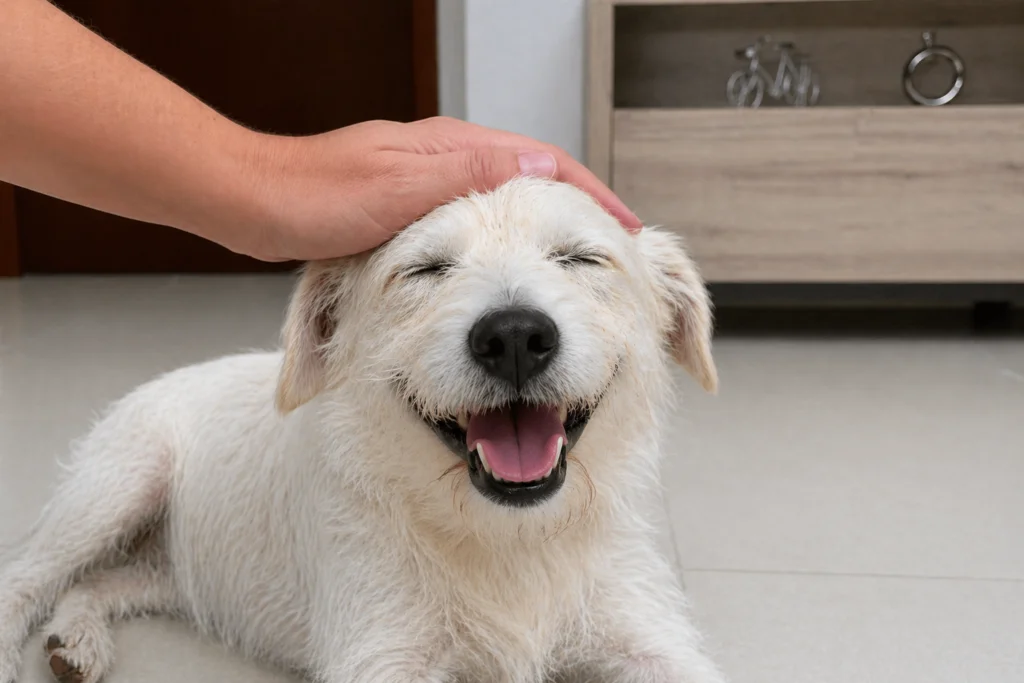
Dog and guardian sharing a positive moment of connection and calm.
You may also like


Lusiane Costa is a digital writer with degrees in Marketing and English Literature.
Creator of Latido Lógico and Logical Bark, she develops evidence-based content on canine aging, wellness, and senior-dog health.
The project was inspired by Goe — a senior dog whose longevity and resilience shaped a grounded, compassionate view on the challenges of aging in pets.
Each article reflects her commitment to transforming real experiences into accessible knowledge, helping owners understand, prevent, and care better for their animals at every stage of life.
Goe remains the heartbeat of this project.
[…] To further explore canine behavior, communication, and emotional routines, this complementary article may also help: https://logicalbark.com/separation-anxiety-in-dogs-causes-and-effective-strategies/ […]
[…] Continue reading with other content related to your dog’s well-being: https://logicalbark.com/separation-anxiety-in-dogs-causes-and-effective-strategies/ […]
[…] 👉 If you’d like to dive deeper into this topic, check out this complementary article: https://logicalbark.com/separation-anxiety-in-dogs-causes-and-effective-strategies/ […]
[…] 👉 Learn more about this subject in the related article below: https://logicalbark.com/separation-anxiety-in-dogs-causes-and-effective-strategies/ […]