October 31, 2026
Witnessing your senior companion — that inseparable friend who has been present in every chapter of your story — turning away from their meal bowl is one of the most agonizing moments in a caregiver’s routine. The silence facing the food usually triggers an immediate tightness in the chest, accompanied by the urgency to understand what is happening. However, the universe of food refusal in canine maturity goes far beyond a simple loss of appetite: often, the pet manifests an intense desire to eat, but hits an invisible physical barrier that prevents them from nourishing themselves.
Deciphering this refusal requires going far beyond the surface, investigating the intricate physiological, neurological, and digestive mechanisms that shape the senior animal’s organism to fully understand what is inappetence in your senior dog.
Understanding what inappetence is in your senior dog
One of the most touching scenarios in geriatric veterinary medicine is when the dog walks slowly to the food bowl, shows clear interest, but retreats desolate without touching anything. The brain sends the hunger signal, but the body fails in execution.
This usually happens due to degenerative and mechanical factors of aging:
- Difficulties in chewing and swallowing: Advanced periodontal conditions, loose teeth, jaw pain, or oral inflammation make the act of grasping food extremely painful.
- Pseudonorexia: There is a fascinating medical term for this condition where the animal avidly wants to eat, but is prevented by physical barriers or intense nausea: pseudonorexia. The dog salivates and desires the food, but the body ends up rejecting the process.
- Systemic and persistent nausea: Metabolic disorders send continuous signals of repulsion to the nervous system, establishing a lasting sensation of nausea that paralyzes the appetite.
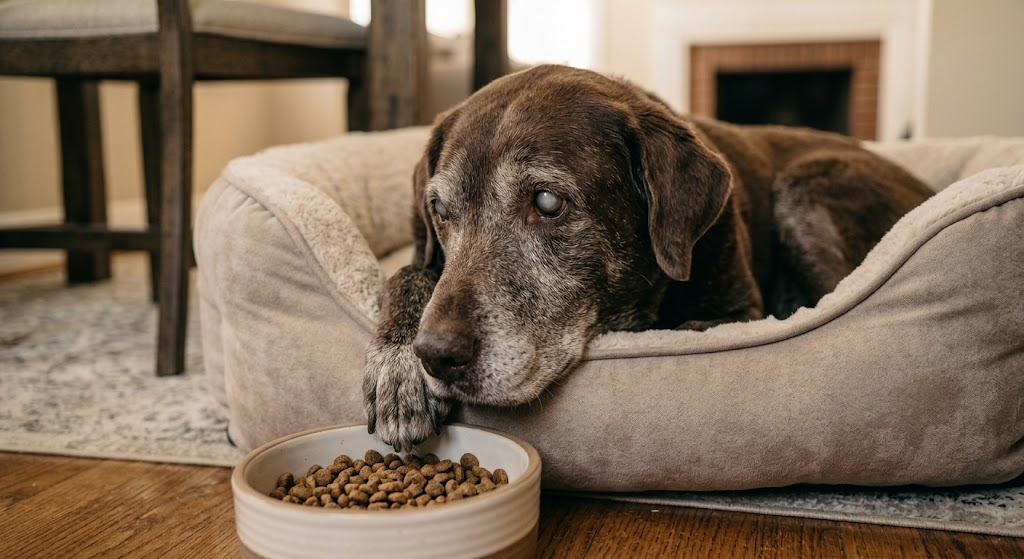
When the bowl is full, it’s time to investigate: understand what inappetence is in your senior dog.
Clinical investigation: where to start uncovering the cause?
When inappetence persists, veterinary conduct must be structured and progressive, prioritizing less invasive methods before advancing to complex investigations:
- Thorough clinical evaluation: The essential starting point, involving abdominal palpation, inspection of the oral cavity, cardiorespiratory auscultation, and checking the hydration status.
- Laboratory tests (blood and biochemical): Indispensable for mapping the function of vital organs, closely investigating renal issues. When the kidneys lose their filtering capacity (as in Chronic Kidney Disease), urea toxins accumulate in the bloodstream, aggressively irritating the gastric mucosa and causing uremia, severe nausea, and aversion to food.
- Abdominal ultrasound and imaging: Allow examining the integrity of internal organs, revealing alterations in the thickness of the gastric and intestinal walls, as well as hidden inflammatory processes.
- Upper digestive endoscopy: Indicated for complex scenarios where conventional exams do not elucidate the picture, allowing the visualization of lesions in the esophagus, stomach, and duodenum, besides enabling biopsies for the diagnosis of deep gastritis.
Why does an empty stomach generate more lack of appetite? Bilious Vomiting Syndrome
A viciously cruel cycle affects the senior dog that stops eating: by spending many hours with the stomach completely empty — especially during the night and dawn —, the organ continues to secrete hydrochloric acid and bile without a truce.
In the absence of food to neutralize these acids, the gastric mucosa suffers corrosive irritation. The result is classic Bilious Vomiting Syndrome, where the dog regurgitates a foamy and yellowish liquid in the early hours of the day.
This stomach discomfort generates prolonged nausea, making the animal associate the act of eating with subsequent pain. Breaking this pattern requires rigorously fractionating the offer of small portions throughout the day and night.
The brain’s nausea centers and the precision of antiemetics
To understand the efficacy of antiemetic medications, it must be remembered that nausea is regulated by complex neurological pathways concentrated in three main nausea centers:
- The vomiting center (medulla oblongata): The final coordinator of the emetic response.
- The vestibular system: Responsible for balance and spatial orientation.
- The Chemoreceptor Trigger Zone (CTZ): Situated outside the blood-brain barrier, highly sensitive to circulating toxins in the blood (such as renal slag).
Each class of antiemetic acts surgically on specific targets of these pathways, blocking dopaminergic or serotonergic receptors (such as ondansetron) and restoring the necessary comfort for the pet to tolerate food again.
The rescue of appetite: stimulants, pain control, and deep treatment of gastritis
Overcoming inappetence requires an integrated therapeutic strategy:
- Rigorous treatment of gastritis and gastric protection: It is impossible to recover appetite with an inflamed stomach. The use of protectors is standard, remembering that substances like ranitidine have fallen into disuse and been severely restricted in modern clinical practice due to concerns about impurities (such as nitrosamines) and the preference for safer proton pump inhibitors (like omeprazol or pantoprazol), always under medical prescription.
- Relief from chronic pain: Senior dogs frequently avoid moving around or lowering their head due to arthrosis or lower back pain. Controlling pain restores mobility and interest in food.
- Appetite stimulants: When nausea and pain are controlled, drugs like capromorelin or mirtazapine act on the central nervous system to reactivate the hunger signal.
In our personal and intimate experience of caring for our Goe, he had all the specialized medical monitoring possible, but the condition was extremely challenging due to the immense number of heavy surgical and clinical procedures he was going through consecutively. Even facing such a complex and exhausting scenario, he was offered intense support with an infinity of nutritional supplements, protectors, and management alternatives to try to shield his organism and guarantee maximum comfort possible at each stage of that journey.
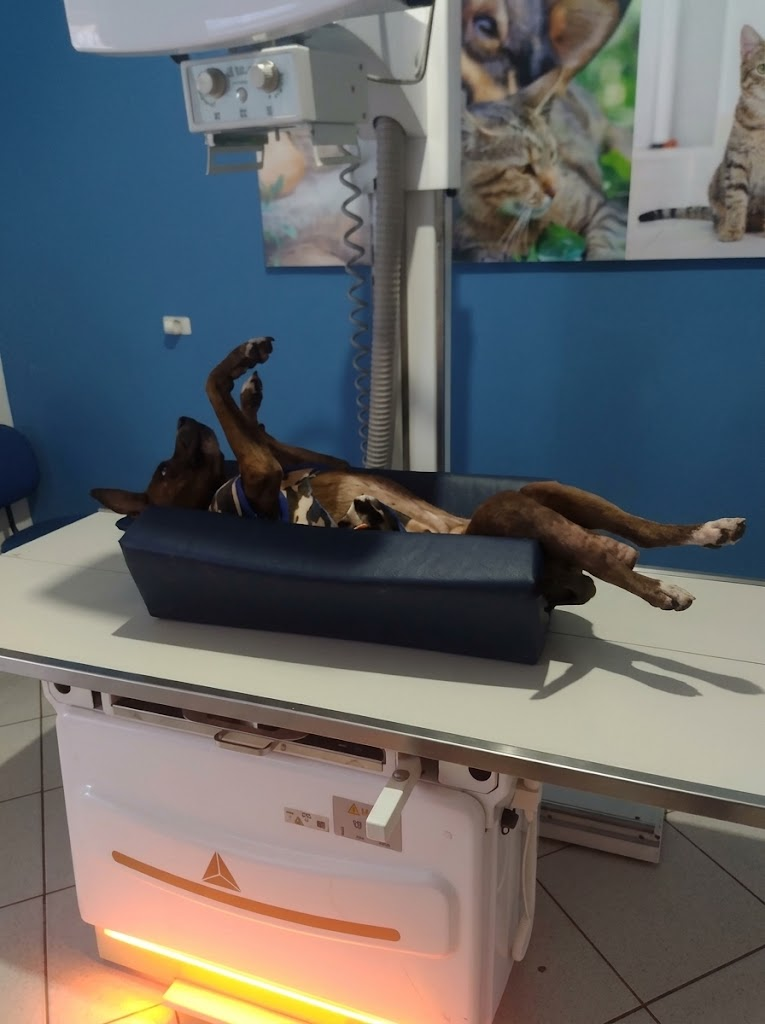
Goe undergoing exams, passing through X-ray tables and procedures to teach us how to deal with challenges and to understand everything that happened to him in each process, including senior dog inappetence.
The transformative importance of a gastrointestinal diet
Once the clinical picture is stabilized, food selection makes all the difference. An industrialized gastrointestinal diet of the highest quality is the gold standard validated by modern veterinary science.
Unlike conventional feeding, this diet is formulated with protein sources of exceptional digestibility, reduced fat content, and a balanced blend of fibers that nourish intestinal cells. It delivers maximum nutritional density in a reduced volume of food, perfectly adapting to the needs of senior dogs with limited gastric capacity.
Some tutors opt for probiotic supplements and palatable pastes to help recover the intestinal flora and stimulate the pet’s appetite. I will leave below a practical example of a product you can check to complement the article: https://link.amazon/B06BGlqX2
Conclusion
Understanding the depth of what inappetence is in your senior dog transforms anguish into care conduct grounded in medicine. Food refusal is never a common situation; it is a silent cry for help. Investigating renal causes, combating gastritis with appropriate drugs, blocking nausea centers, and offering excellence nutritional support, you welcome your faithful companion with the dignity and respect they deserve in the most sensitive phase of their life.
👉 This subject is also related to the content we present in this article: https://logicalbark.com/what-can-cause-paw-pain-in-older-dogs/
Medical Disclaimer: This article has a strictly informational and educational character and does not replace in any way the evaluation, diagnosis, and prescription of a veterinarian. Each organism reacts uniquely to treatments; therefore, never administer medications, stimulants, or change your senior dog’s diet without the direct guidance of the professional accompanying their clinical history.
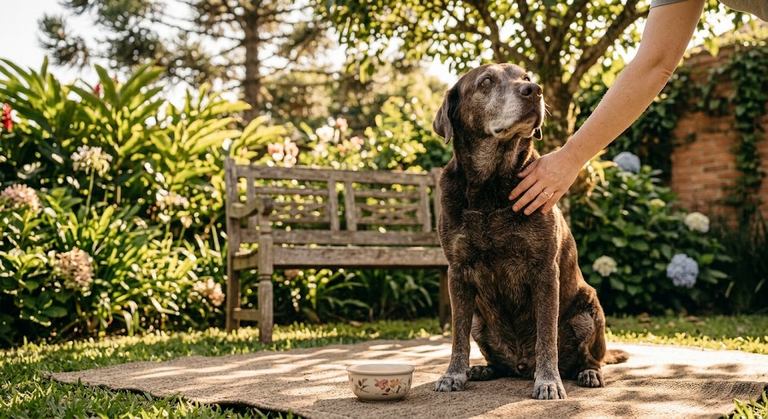
With the correct diagnosis, appropriate management, and a true task force of love and veterinary care, the senior dog can indeed recover its appetite, renew its energy, and live with the quality and joy it deserves.
You may also like

Lusiane Costa is a digital writer with degrees in Marketing and English Literature.
Creator of Latido Lógico and Logical Bark, she develops evidence-based content on canine aging, wellness, and senior-dog health.
The project was inspired by Goe — a senior dog whose longevity and resilience shaped a grounded, compassionate view on the challenges of aging in pets.
Each article reflects her commitment to transforming real experiences into accessible knowledge, helping owners understand, prevent, and care better for their animals at every stage of life.
Goe remains the heartbeat of this project.