
June 14, 2026
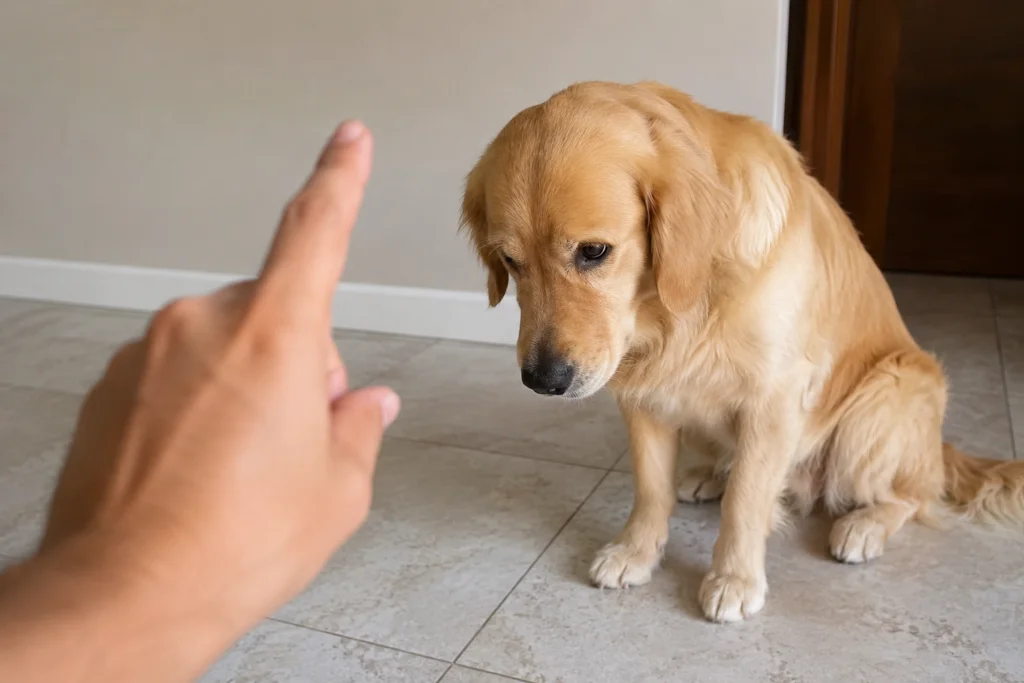
What Do Dogs Feel When They Are Disciplined?
Behavior changes more effectively when trust remains intact.
Disclaimer: This content is intended for informational and educational purposes only. The information presented here does not replace an individual assessment by a veterinarian, animal behaviorist, or other qualified canine behavior professional, especially in cases involving severe fear, anxiety, aggression, or significant behavioral changes.
What do dogs feel when they are disciplined? This question reflects a growing concern among dog owners who want to guide their dogs without resorting to impulsive, intimidating, or emotionally harmful reactions. More than a practical question, it invites us to reflect on learning, bonding, and trust.
Before understanding what dogs feel when they are disciplined, it is important to recognize that canine behavior cannot be interpreted in simplistic ways. Dogs do not learn solely from the commands they receive, but from the emotional experiences they share with their humans. Tone of voice, body language, routine predictability, and the quality of the relationship directly influence how dogs understand the world around them.
Living with GOE made this understanding even clearer. As a pit bull, he carried many socially constructed stereotypes, most of them profoundly disconnected from reality. The belief that certain breeds are naturally aggressive is an oversimplified view of canine life. A dog’s behavior is never determined by a single factor; it emerges through the interaction of biological predispositions, life experiences, and the bonds developed throughout life.
GOE embodied gentleness, sensitivity, and loyalty. His presence taught us that reducing a dog to its breed means overlooking the unique individuality that exists within every animal. Fear was never the foundation of our relationship with him—trust was. And that trust, built through everyday interactions, demonstrated that dogs respond best when they experience safety, consistency, and respect.
When we ask what dogs feel when they are disciplined, animal behavior science suggests that they may experience fear, insecurity, confusion, anxiety, and a loss of predictability. Unlike humans, dogs do not interpret correction as a moral judgment. They do not think in terms of guilt, revenge, or intentional disobedience. Instead, they perceive signals: tone of voice, body tension, facial expressions, and emotional changes in their environment.
Because of this, when a person raises their voice or reacts with frustration, the dog may not understand exactly which behavior should change. Often, the dog simply learns that something unpleasant or threatening has occurred. This experience may temporarily stop a behavior, but it does not necessarily teach what should replace it.
This is where many training approaches fail. Discouraging behavior without providing guidance may create silence, but not always learning. A dog may stop because of fear, but not because of understanding. The distinction is significant. Fear interrupts. Trust teaches.
Understanding what dogs feel when they are disciplined requires looking beyond visible behavior. A dog that lowers its body, avoids eye contact, licks its lips, hides, or withdraws may be displaying signs of emotional discomfort. These behaviors should not be interpreted as “guilt,” but rather as appeasement signals in response to a situation perceived as stressful.
Educating a dog does not mean allowing everything. It means teaching with clarity. Boundaries are necessary, but they do not need to be accompanied by intimidation. Dogs need to understand what is acceptable, which behaviors are desirable, and what alternatives are available when a behavior is inappropriate.
If a dog chews household items, for example, the most effective solution is not simply reprimanding the dog. The first step is understanding the reason behind the behavior. The dog may be bored, anxious, exploring the world through its mouth, or lacking appropriate outlets for energy. In these situations, removing the inappropriate item, providing suitable chew toys, enriching the environment, and rewarding appropriate choices often produce more sustainable results.
If a dog barks for attention, the response also needs to be strategic. In many cases, providing attention at the exact moment of barking unintentionally reinforces the behavior. Withdrawing attention during persistent barking and rewarding calm moments can communicate much more clearly which behaviors are preferred.
If a dog jumps on visitors, its energy can be redirected toward an incompatible behavior, such as sitting, remaining in a designated spot, or carrying a toy. The principle is simple: instead of merely stopping the unwanted behavior, teach a more appropriate alternative.
Positive reinforcement plays a central role in this process. Treats, affection, praise, toys, and attention can all function as rewards when delivered at the right moment. The goal is not to “buy” behavior but to clearly communicate which actions lead to positive outcomes.
Therefore, when considering what dogs feel when they are disciplined, it is equally important to ask: what do dogs feel when they are guided calmly? Generally, they experience greater predictability, security, and willingness to cooperate. Learning becomes clearer when the emotional environment is not dominated by tension.
Trust between dogs and their humans is fundamental to healthy coexistence. It is not built through grand gestures, but through the small repetitions of daily life: the way a dog is called, guided, comforted, and corrected. Every interaction communicates something. Every human response teaches something.
Through my experience with GOE, I learned that the most consistent results emerged from calmness and consistency. There was no need to turn education into confrontation. It was enough to understand the moment, redirect attention, and reinforce the desired behavior. This approach respected his sensitivity and preserved the most valuable aspect of our relationship: our bond.
This reflection matters because many people believe obedience is achieved through dominance and imposition. However, behavioral science increasingly demonstrates that learning supported by trust tends to be more stable because it does not depend on fear. Dogs learn because they understand the positive consequences of their actions, not because they fear human reactions.
Once we understand what dogs feel when they are disciplined, it becomes possible to replace impulsive reactions with more thoughtful educational strategies. Instead of reacting solely to mistakes, we can organize the environment to encourage success. Instead of interpreting behavior as a personal challenge, we can recognize it as communication.
A dog that destroys objects, barks, jumps, persists, or seeks attention is not necessarily challenging its human. Often, the dog is expressing a need, insecurity, excess energy, or a lack of clear guidance. Behavior is a language. Education begins when we learn how to listen.
Therefore, before discouraging a behavior, seek to understand it. Before correcting, provide guidance. Before demanding obedience, build trust.
Dogs do not need to fear their humans in order to learn. They need to recognize them as safe, predictable, and emotionally consistent figures. The deepest learning does not emerge from intimidation, but from relationship.
What Can You Do in Practice? Strategies That Often Work Better
Understanding what dogs feel when they are disciplined is important. Equally important is knowing which alternatives can help teach more appropriate behaviors in everyday situations.
When Your Dog Chews Furniture or Household Objects
Instead of focusing only on stopping the behavior, provide safe chewing alternatives.
- Offer age- and size-appropriate chew toys.
- Rotate toys regularly to maintain interest.
- Remove items that may create excessive temptation.
- Reward your dog whenever they choose an appropriate item.
The goal is not only to prevent chewing but to teach what is acceptable to chew.
If you’re interested, many dog owners report excellent results when providing appropriate chewing toys. For convenience, we are sharing one option that may help redirect this behavior safely and enrichingly: https://amzn.to/4e7J0UW
When Your Dog Jumps on Visitors
Many dogs jump simply because they are excited and seeking interaction.
- Avoid rewarding jumping with immediate attention.
- Ask visitors to ignore the jumping behavior.
- Reinforce incompatible behaviors such as sitting or keeping all four paws on the ground.
- Offer affection and attention as soon as your dog becomes calm.
Over time, dogs learn that calm behaviors produce better outcomes.
When Your Dog Barks Excessively
Before trying to stop barking, understand why it is happening.
Barking may be related to:
- Boredom
- Anxiety
- Attention-seeking
- Alerting behavior
- Excess energy
After identifying the cause:
- Increase environmental enrichment.
- Provide age-appropriate physical activity.
- Reward calm moments.
- Avoid turning barking into a competition of who can be louder.
Understanding the origin of the behavior is always more effective than simply trying to suppress it.
When Your Dog Constantly Seeks Attention
In some situations, any human response can function as reinforcement.
A commonly effective strategy is:
- Briefly withdraw attention.
- Wait for a calmer behavior.
- Offer attention only when your dog is relaxed.
This helps the dog learn which behavior produces the desired result.
👉 This article may complement the information presented here:
The Most Important Principle
Perhaps the question is not simply:
How do I correct a behavior?
But rather:
What behavior do I want to teach instead?
When this shift in perspective occurs, education becomes less about correction and more about development.

Where trust exists, learning finds its way.
You may also like

Lusiane Costa is a digital writer with degrees in Marketing and English Literature.
Creator of Latido Lógico and Logical Bark, she develops evidence-based content on canine aging, wellness, and senior-dog health.
The project was inspired by Goe — a senior dog whose longevity and resilience shaped a grounded, compassionate view on the challenges of aging in pets.
Each article reflects her commitment to transforming real experiences into accessible knowledge, helping owners understand, prevent, and care better for their animals at every stage of life.
Goe remains the heartbeat of this project.