August 2, 2026
A dog’s coat functions as a mirror of internal health. Understand what science says about hair loss in senior dogs and know when to investigate.
The Biology of Hair: A Dynamic and Living Barrier
Many dog owners associate the coat merely with aesthetics, but for veterinary dermatology, hair is a complex and vital biological structure. It plays a role in body thermoregulation, protects the epidermis against ultraviolet (UV) radiation, prevents contact with excessive moisture, and acts as a barrier against pathogenic microorganisms.
Each hair strand has an independent lifecycle composed of three main phases:
- Anagen: active growth phase of the strand.
- Catagen: transition and regression phase of the follicle.
- Telogen: resting phase, where the old hair sheds to make room for a new cycle.
Since the biological clock of each hair follicle is not synchronized, moderate, daily shedding is part of the normal physiology of the dog.
After All, Is It Normal for an Older Dog to Lose Hair?
The short answer is: yes, to a certain extent. As the dog ages, natural changes occur in cellular renewal, peripheral blood circulation, and the dog’s metabolism. The rate of tissue regeneration decreases, which can naturally make the coat a bit thinner, drier, or less dense.
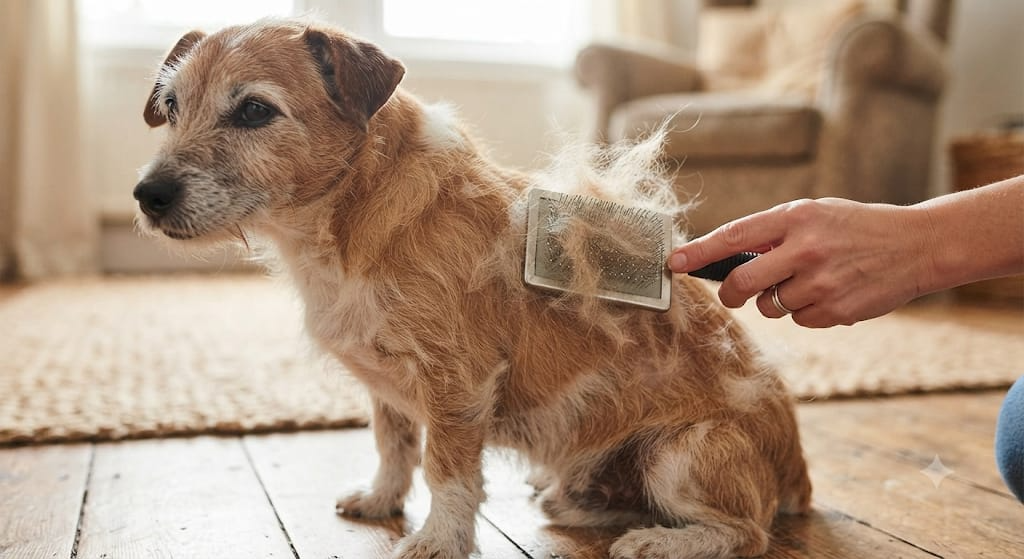
However, asking if is it normal for an older dog to lose hair requires attention to detail. Shedding ceases to be physiological and becomes pathological when visible bald spots (alopecia), redness, itching, or changes in skin texture occur.
Physiological vs. Pathological Shedding: Comparison Table
To help with quick identification in daily life, the table below summarizes the crucial differences between healthy hair shedding and warning signs that require veterinary evaluation:
| Parameter | Physiological Shedding (Normal) | Pathological Shedding (Investigate) |
|---|---|---|
| Distribution | Uniform across the entire body. | Localized, with bald spots or symmetrical on the flanks. |
| Skin Appearance | Intact, without redness, dander, or sores. | Erythematous (red), scaly, darkened, or thickened. |
| Pruritus (Itching) | Absent or very occasional (normal everyday itch). | Intense; the dog licks, bites, or scratches frequently. |
| Hair Texture | Residual shine and good overall coverage. | Dull, brittle, dry, or falling out in clumps. |
| Systemic Signs | Active dog, eating and drinking water normally. | Lethargy, weight gain or loss, increased water intake. |
Main Causes of Excessive Shedding in Senior Dogs
When hair loss exceeds the limits of natural renewal in seniors, the underlying causes usually involve:
1. Hormonal and Endocrine Imbalances
Conditions such as hypothyroidism (decrease in thyroid hormone production) and Cushing’s Syndrome (hyperadrenocorticism) are common in the senior phase. They alter the hair follicle cycle, keeping the hair in the resting phase longer and preventing new strands from growing, resulting in symmetrical hair loss and thin skin.
2. Dermatitis and Allergies
Food allergies or flea allergy dermatitis (FAD) cause inflammation in the skin barrier. Continuous scratching and licking traumatize the strands and mechanically remove them, creating bald spots and secondary bacterial or fungal infections.
3. Nutritional Deficiencies and Absorption
The skin and coat consume a significant portion of the proteins and fatty acids ingested by the dog. If the senior dog’s intestinal absorption is reduced or if the diet lacks essential nutrients, the hair strands become weak and brittle.
Investigation Checklist for the Owner
If you have noticed an increase in hair around the house, ask yourself the following questions before the veterinary visit:
- Has the shedding pattern changed recently or has it always been like this?
- Are there areas with obvious bald spots in the coat?
- Does the dog scratch, lick, or bite any specific region?
- Has the skin changed color (became dark/hyperpigmented) or texture?
- Is there presence of dander or a different odor on the skin?
- Has the dog shown weight gain, excessive fatigue, or increased thirst?
- Is flea and tick control strictly up to date?
If the answer is “yes” to any of the changes or questions above, a clinical investigation with blood tests and skin scrapings becomes essential.
Nutraceuticals and Care That Protect the Senior Coat
To keep the coat strong in the senior dog, science supports nutritional support strategies and physical management:
- Omega-3 (EPA + DHA): essential fatty acids extracted from deep-water fish that act in modulating the inflammatory response, reduce itching, and strengthen the skin’s lipid barrier.
- Mobility and General Health Supplements: chondroprotectants (such as glucosamine and chondroitin) and antioxidants help maintain systemic vitality, reducing oxidative stress that directly and indirectly affects the quality of the skin and follicle.
- Regular Brushing: daily use of suitable brushes removes loose, dead hair, stimulates local blood circulation, and prevents matting.
- Shampoo with Proper pH: use only veterinary hygiene products, ensuring respect for the physiological pH of canine skin (which ranges between 6.2 and 7.4, unlike human skin).
💡 Supplementation Tip:
Since many readers often ask me for supplement recommendations, here are a few highly recognized, top-quality Omega-3 and mobility products that were also used by Goe throughout his life.
👉 Check out the primary Omega-3 option: https://amzn.to/4w7E9IR
👉 Check out a more affordable option: https://amzn.to/4yUGGbY
⚠️ Remember: before introducing anything new to your dog’s routine, it is essential to consult your veterinarian to adjust the ideal dosage for their health.
My Experience with Goe: Time, Hair, and the Delicacy of Aging
When we look at scientific literature, we understand the theory. But it is in the daily home routine, in the daily touch, that science gains heart. That was the case with my beloved senior Pitbull, Goe.
As age advanced, I noticed the transformations in his body. My senior Pitbull’s situation could be just normal or indicate deeper health issues, such as hormonal changes or skin conditions that require a watchful eye. Goe shed hair, yes, but not in excess — it was that serene change marked by the passage of time and some allergies he faced throughout his life.
To protect his sensitive skin and overall health, I maintained rigorous and loving care. I invested heavily in strategic supplementation: I offered mobility supplements to care for his joints and the indispensable Omega-3, which provided anti-inflammatory support for his skin, keeping the remaining hair nourished and the skin barrier fortified against allergic flare-ups.
Watching Goe age taught me that a dog’s coat is a biological archive of affection. Every hair that appeared around his eyes and every strand that came loose told the story of a life fully lived, protected, and loved. Knowing that is it normal for an older dog to lose hair within the limits of age, I transformed every brushing session into a ritual of care — my daily way of telling Goe that the fragility of time would never diminish our connection.
👉 If this topic piqued your interest, you might also enjoy this article: https://logicalbark.com/what-is-aging-alongside-a-dog-for-16-years/
Disclaimer / Legal Notice: The information contained in this article is exclusively for educational, informative, and preventive purposes, reflecting good veterinary management practices and real experiences from dog owners. This content does not replace consultation, dermatological diagnosis, or monitoring by a licensed veterinarian. If your senior dog displays severe hair loss, sores, intense itching, or behavioral changes, consult a professional immediately.
You may also like

Lusiane Costa is a digital writer with degrees in Marketing and English Literature.
Creator of Latido Lógico and Logical Bark, she develops evidence-based content on canine aging, wellness, and senior-dog health.
The project was inspired by Goe — a senior dog whose longevity and resilience shaped a grounded, compassionate view on the challenges of aging in pets.
Each article reflects her commitment to transforming real experiences into accessible knowledge, helping owners understand, prevent, and care better for their animals at every stage of life.
Goe remains the heartbeat of this project.