September 16, 2026
When we think about the health and well-being of a senior dog, our attention usually turns immediately to what enters through their mouth or the quality of the air they breathe. Rarely do we stop to look closely at the floor of our own house, that same floor where our companion spends most of the day lying down, resting tired bones and supporting the weight of a body that has already accumulated years of experience. However, there is an extremely silent, constant, and often overlooked toxin absorption route in the domestic routine: paw intoxication (intoxicação pelas patas). For a senior dog, whose filtering organs—such as the liver and kidneys—already operate at a slower pace worn down by time, continuous contact with chemical residues left behind by household cleaning can turn into a serious health problem.
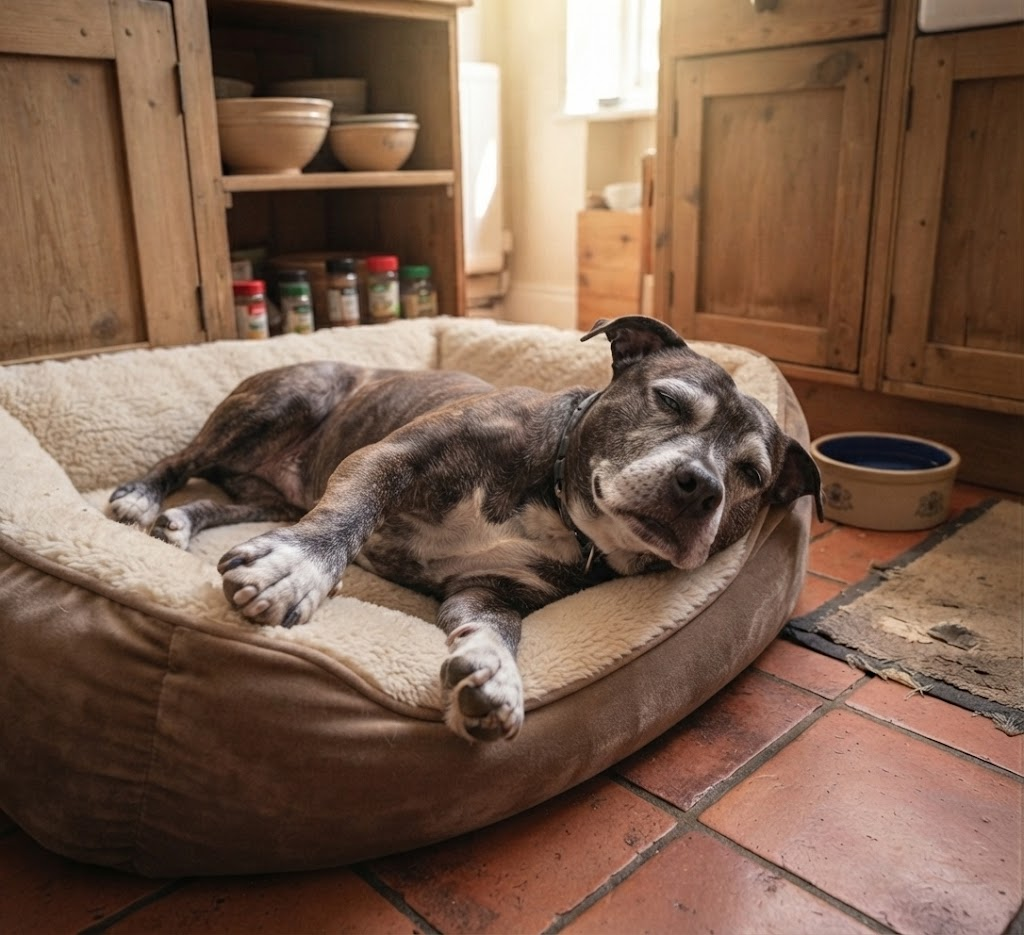
A safe and chemical-free rest is the best prevention against paw intoxication in your senior dog.
When we think about the health and well-being of a senior dog, our attention usually turns immediately to what enters through their mouth or the quality of the air they breathe. Rarely do we stop to look closely at the floor of our own house, that same floor where our companion spends most of the day lying down, resting tired bones and supporting the weight of a body that has already accumulated years of experience. However, there is an extremely silent, constant, and often overlooked toxin absorption route in the domestic routine: paw intoxication (intoxicação pelas patas). For a senior dog, whose filtering organs—such as the liver and kidneys—already operate at a slower pace worn down by time, continuous contact with chemical residues left behind by household cleaning can turn into a serious health problem.
Understanding the phenomenon of paw intoxication requires looking away from obvious major veterinary emergencies and focusing on everyday micro-details. We are not talking about that dramatic accident where the animal ingests a highly toxic product all at once, but rather a chronic, cumulative, and invisible process. The dog walks on the clean floor, lies down on the freshly sanitized surface, and subsequently performs one of the most natural habits of its species: licking its own paws to clean itself. It is precisely in this simple dynamic that the danger materializes, turning household cleaning care into a hidden source of organic wear and tear for the senior animal.
The obscure path from cleaning products to the organism
The cleaning routine of a modern home involves an impressive variety of chemical agents. We use scented disinfectants, multi-purpose cleaners, bleaches, strippers, and waxes to ensure the environment sparkles and smells pleasant to our own senses. The big misconception is believing that once the floor dries, the product has ceased to exist. In practice, what occurs is the formation of an invisible film of dry chemical residues adhered directly to the surface where the animal walks all day long.
To understand paw intoxication, we need to examine the pathways through which these substances enter the dog’s body:
- Dermal and cutaneal absorption: The paw pads (coxins) of dogs have a high concentration of nerve endings and superficial blood vessels. Although coated with skin that is thicker and more resistant than ours, they are not impermeable. Prolonged and daily contact with floors treated with chlorine, quaternary ammonia, and synthetic fragrances causes small chemical molecules to be absorbed directly through the skin, entering the animal’s bloodstream without encountering any significant barrier.
- Ingestion through licking: Dogs are animals that rely heavily on personal hygiene through their tongues. After walking around the house or simply getting up from a nap, it is common for them to clean their paws and the spaces between their toes. By doing so, they orally ingest all the chemical residue accumulated on the surface of the pads. Multiply this behavior dozens of times a day, over weeks and years, and we have a clear picture of continuous metabolic overload.
- Inhalation and contact with fur: Since the senior dog spends many hours lying belly down or curled up on the floor, the fur on its chest, abdomen, and muzzle also absorbs and retains these volatile particles and physical floor residues, creating a cross-exposure that affects both the respiratory system and the skin simultaneously.
In young and healthy animals, the body can often process and excrete these small daily loads of toxins without manifesting alarming symptoms. However, in the senior dog, the story is completely different. A slowed basal metabolism means that the liver and kidneys must work at their capacity limit to filter the body’s natural metabolic subproducts. Adding to this equation the requirement to metabolize synthetic chemical compounds coming from cleaning products is the perfect trigger to generate chronic fatigue, persistent skin irritations, and a drop in overall immunity.
Paw dermatitis and warning signs
One of the most immediate and visible reflexes of paw intoxication and aggressive contact with chemical flooring is the development of localized dermatological conditions, frequently known in clinical routine as contact dermatitis or pad irritations. When the sensitive skin of the paw reacts poorly to environmental chemical agents, the animal’s body emits clear signs that the attentive owner must learn to decode before the condition evolves into secondary infections.
Symptoms typically manifest in well-defined layers of observation:
- Local and cutaneal signs: The paws show evident redness (erythema) in the area between the toes and in the interdigital membranes. The pads may appear excessively dry, rough, prone to painful cracks, or conversely, excessively softened and sensitive to touch. The dog begins to show discomfort when walking on cold or rough surfaces, subtly changing its support posture.
- Behavioral signs: The most classic symptom of chemical irritation and paw intoxication is behavioral persistence. The dog begins to lick, nibble, or suck its paws obsessively, repetitively, and often compulsively. To the inattentive owner, this may seem like a common cleaning habit, but most of the time it is a desperate attempt by the animal to relieve intense itching, burning, or the stinging sensation caused by chemical residues stuck to the skin.
- Oral, abdominal, and systemic signs: Since the animal ends up ingesting a considerable amount of these products when trying to lick itself, the digestive system also suffers the impact. It is not uncommon to observe mild episodes of abdominal nausea, excess salivation (hypersalivation), temporary rejection of food, subtle apathy, or sporadic vomiting episodes shortly after household cleaning times. The systemic accumulation of these toxins in the senior dog’s body generates generalized fatigue that goes far beyond a simple sign of old age.
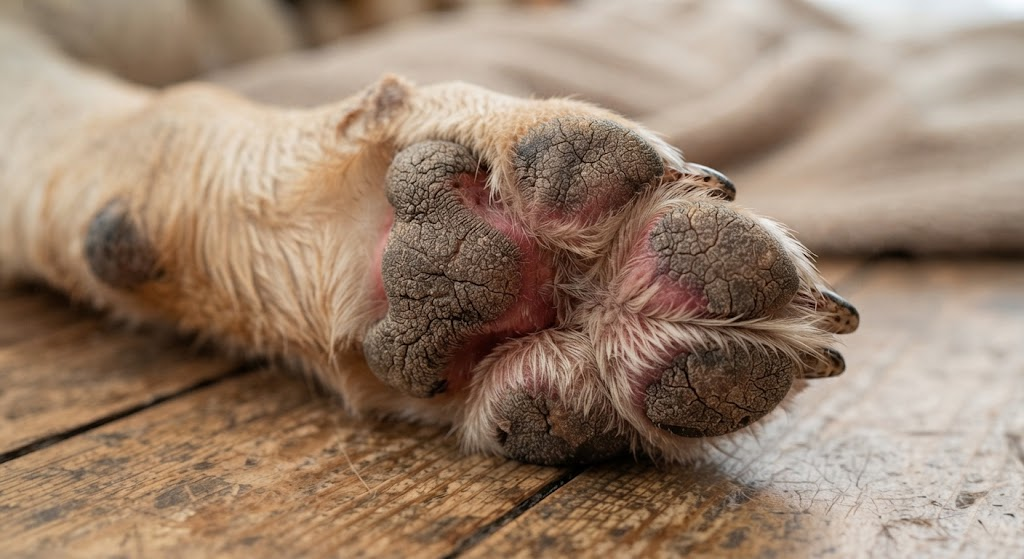
Redness and irritation on the paw pads: these are some of the most evident signs of paw intoxication in the senior dog.
What to do to protect your senior dog
Facing the problem of paw intoxication does not mean turning your home into a sterile environment or giving up the cleaning necessary to maintain household hygiene. The secret lies in the strategic change of products, the alteration of the application method, and above all, the reformulation of the coexistence routine during and after cleaning.
To ensure your senior dog lives with comfort and safety, some practical measures must be implemented immediately:
- Replace aggressive chemical agents: Eliminate common disinfectants loaded with heavy chlorine, strong ammonias, and long-lasting synthetic fragrances from your shopping list. Prefer pet-specific enzymatic cleaning products or established and safe alternatives, such as the moderate use of neutral soap or diluted solutions of rubbing vinegar for routine surface cleaning.
- Adopt double rinsing: Whenever you mop the floor using any cleaning product (even those considered milder), create the rigorous habit of performing a second rinse using only clean water. This simple procedure physically removes the chemical residue film that would normally dry on the floor, preventing it from coming into direct contact with the animal’s paws.
- Maintain isolation during drying: The most critical moment of exposure occurs while the floor is still damp or freshly dried, as vapor release and direct contact transfer reach their peak.
Many owners use alternative products, such as pet enzymatic products, which clean effectively without harming the animal’s health. To complement the article, here is an example for awareness: https://amzn.to/4hai0nQ
It is by studying canine aging that we learn and realize small factors make a difference in their quality of life. In my case, whenever the house was cleaned, I started placing them in a separate room, because all of this is a set that corroborates the dog’s quality of life.
Protecting your companion against invisible environmental hazards does not require magical formulas or complex treatments; it requires only respect for their biological time, attention to the smallest details, and the certainty that true care is the pure air breathed, the respected space, and the quality of life of dogs.
For a more comprehensive view, we recommend reading this related article: https://logicalbark.com/what-are-the-dangers-at-home-for-older-dogs/
The silent path: from cleaning products to the organism The cleaning routine of a modern home involves an impressive variety of chemical agents. We use scented disinfectants, multi-purpose cleaners, bleaches, strippers, and waxes to ensure the environment sparkles and smells pleasant to our own senses. The big misconception is believing that once the floor dries, the product has ceased to exist. In practice, what occurs is the formation of an invisible film of dry chemical residues adhered directly to the surface where the animal walks all day long.
To understand paw intoxication, we need to examine the pathways through which these substances enter the dog’s body:
- Dermal and cutaneal absorption: The paw pads of dogs have a high concentration of nerve endings and superficial blood vessels. Although coated with skin that is thicker and more resistant than ours, they are not impermeable. Prolonged and daily contact with floors treated with chlorine, quaternary ammonia, and synthetic fragrances causes small chemical molecules to be absorbed directly through the skin, entering the animal’s bloodstream without encountering any significant barrier.
- Ingestion through licking: Dogs are animals that rely heavily on personal hygiene through their tongues. After walking around the house or simply getting up from a nap, it is common for them to clean their paws and the spaces between their toes. By doing so, they orally ingest all the chemical residue accumulated on the surface of the pads. Multiply this behavior dozens of times a day, over weeks and years, and we have a clear picture of continuous metabolic overload.
- Inhalation and contact with fur: Since the senior dog spends many hours lying belly down or curled up on the floor, the fur on its chest, abdomen, and muzzle also absorbs and retains these volatile particles and physical floor residues, creating a cross-exposure that affects both the respiratory system and the skin simultaneously.
In young and healthy animals, the body can often process and excrete these small daily loads of toxins without manifesting alarming symptoms. However, in the senior dog, the story is completely different. A slowed basal metabolism means that the liver and kidneys must work at their capacity limit to filter the body’s natural metabolic subproducts. Adding to this equation the requirement to metabolize synthetic chemical compounds coming from cleaning products is the perfect trigger to generate chronic fatigue, persistent skin irritations, and a drop in overall immunity.
Paw dermatitis and warning signs
One of the most immediate and visible reflexes of paw intoxication and aggressive contact with chemical flooring is the development of localized dermatological conditions, frequently known in clinical routine as contact dermatitis or pad irritations. When the sensitive skin of the paw reacts poorly to environmental chemical agents, the animal’s body emits clear signs that the attentive owner must learn to decode before the condition evolves into secondary infections.
Symptoms typically manifest in well-defined layers of observation:
- Local and cutaneal signs: The paws show evident redness (erythema) in the area between the toes and in the interdigital membranes. The pads may appear excessively dry, rough, prone to painful cracks, or conversely, excessively softened and sensitive to touch. The dog begins to show discomfort when walking on cold or rough surfaces, subtly changing its support posture.
- Behavioral signs: The most classic symptom of chemical irritation and paw intoxication is behavioral persistence. The dog begins to lick, nibble, or suck its paws obsessively, repetitively, and often compulsively. To the inattentive owner, this may seem like a common cleaning habit, but most of the time it is a desperate attempt by the animal to relieve intense itching, burning, or the stinging sensation caused by chemical residues stuck to the skin.
- Oral, abdominal, and systemic signs: Since the animal ends up ingesting a considerable amount of these products when trying to lick itself, the digestive system also suffers the impact. It is not uncommon to observe mild episodes of abdominal nausea, excess salivation (hipersalivação), temporary rejection of food, subtle apathy, or sporadic vomiting episodes shortly after household cleaning times. The systemic accumulation of these toxins in the senior dog’s body generates generalized fatigue that goes far beyond a simple sign of old age.
What to do to protect your senior dog
Facing the problem of paw intoxication does not mean turning your home into a sterile environment or giving up the cleaning necessary to maintain household hygiene. The secret lies in the strategic change of products, the alteration of the application method, and above all, the reformulation of the coexistence routine during and after cleaning.
To ensure your senior dog lives with comfort and safety, some practical measures must be implemented immediately:
- Replace aggressive chemical agents: Eliminate common disinfectants loaded with heavy chlorine, strong ammonias, and long-lasting synthetic fragrances from your shopping list. Prefer pet-specific enzymatic cleaning products or established and safe alternatives, such as the moderate use of neutral soap or diluted solutions of rubbing vinegar for routine surface cleaning.
- Adopt double rinsing: Whenever you mop the floor using any cleaning product (even those considered milder), create the rigorous habit of performing a second rinse using only clean water. This simple procedure physically removes the chemical residue film that would normally dry on the floor, preventing it from coming into direct contact with the animal’s paws.
- Maintain isolation during drying: The most critical moment of exposure occurs while the floor is still damp or freshly dried, as vapor release and direct contact transfer reach their peak.
It is by studying canine aging that we learn and realize small factors make a difference in their quality of life. In my case, whenever the house was cleaned, I started placing them in a separate room, because all of this is a set that corroborates the dog’s quality of life.
Protecting your companion against invisible environmental hazards does not require magical formulas or complex treatments; it requires only respect for their biological time, attention to the smallest details, and the certainty that true care is the pure air breathed, the respected space, and the quality of life of dogs.
Notice: The content of this site reflects experiences and insights in the canine universe, serving as support for owners, but without replacing the monitoring of a veterinarian.
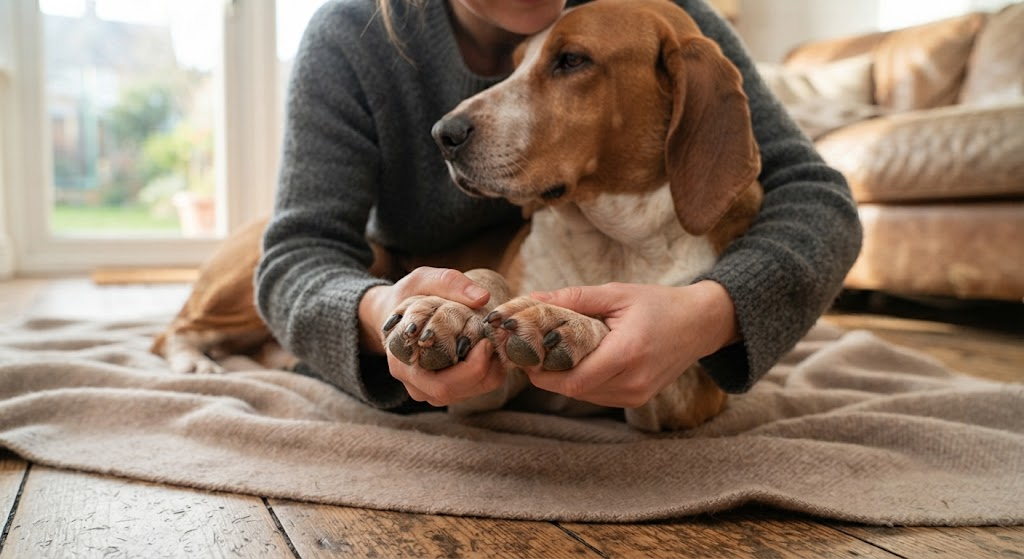
Taking care of the paw pads is a non-negotiable commitment: the conscious care of the owner is the true foundation for the longevity and tranquility of the senior dog.
You may also like

Lusiane Costa is a digital writer with degrees in Marketing and English Literature.
Creator of Latido Lógico and Logical Bark, she develops evidence-based content on canine aging, wellness, and senior-dog health.
The project was inspired by Goe — a senior dog whose longevity and resilience shaped a grounded, compassionate view on the challenges of aging in pets.
Each article reflects her commitment to transforming real experiences into accessible knowledge, helping owners understand, prevent, and care better for their animals at every stage of life.
Goe remains the heartbeat of this project.