March 1, 2026
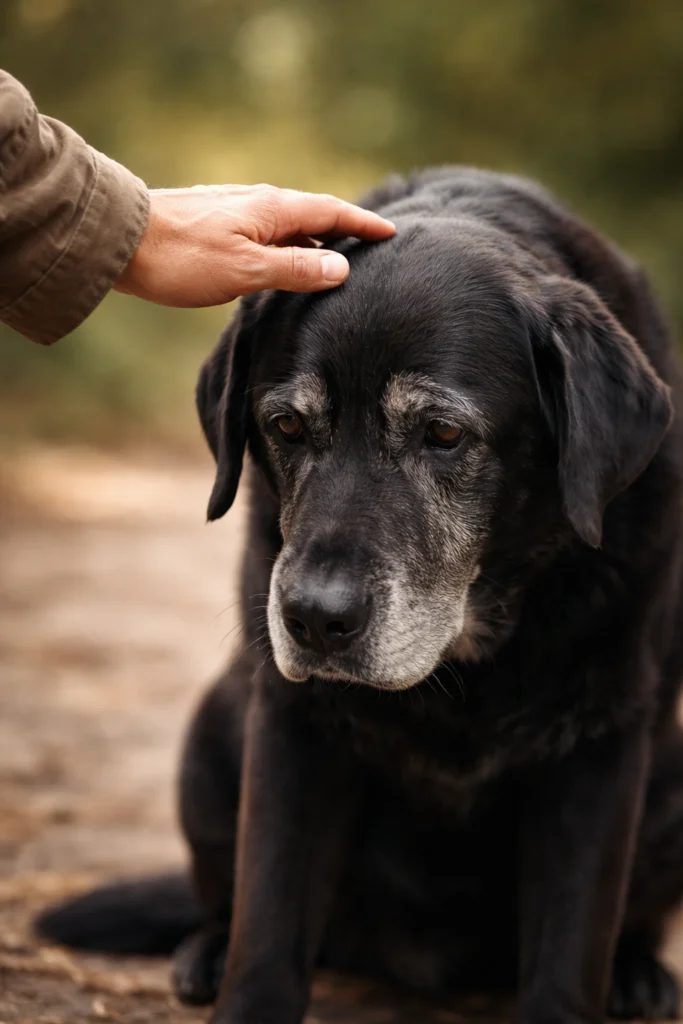
When a senior dog begins to refuse affection, touch may be revealing more than behavior
Have you known senior dogs that suddenly begin avoiding touch?
That animal who always sought closeness, accepted petting, and remained calm during affection may begin to move away, shift position, or show slight discomfort when someone makes contact.
When a senior dog begins to refuse affection, the immediate interpretation is often behavioral. Many assume a change in temperament, “bad mood,” or simply a preference for being alone. However, in many situations, the body is involved in this change.
Refusal of affection in a senior dog rarely appears without physical context.
Aging changes the relationship with touch
With advancing age, important structural changes occur. Joints become less flexible, muscle mass decreases, and small inflammatory processes become part of biological routine.
Touch, which was once neutral or pleasurable, may become uncomfortable when there is sensitivity in:
- Hips
- Shoulders
- Lower back
- Neck
- Thoracic spine
In many cases, the dog does not show obvious pain while walking, yet reacts subtly to manual contact. Sensitivity to touch in senior dogs is often one of the earliest signs that something has changed in the body.
Three possibilities when a senior dog begins to refuse affection
1. Joint or muscular pain
The most common cause is localized pain. Osteoarthritis, joint stiffness, or muscle tension can make physical contact less tolerable.
The issue is not the affection itself, but the involuntary pressure applied to a sensitive area. A simple stroke over the hip may cause discomfort the guardian does not perceive.
When a senior dog begins to refuse affection, observe:
- Does the dog avoid leaning a specific side of the body?
- Does the dog move away when touched in a particular region?
- Does the dog show tension when handled?
These details help differentiate behavioral change from physical discomfort.
Support for joint pain in senior dogs
When joint pain or muscular discomfort is suspected, appropriate support may help improve mobility and overall well-being.
Some joint-support products have been well evaluated by guardians and are often integrated into care strategies, always with veterinary guidance.
See some recommended options for joint pain in senior dogs: https://amzn.to/4slv0Lv
2. Cutaneous hypersensitivity
With aging, the skin may become thinner and more sensitive. Minor dermatological changes, itching, or subtle inflammation can also interfere with tolerance to touch.
The dog may associate petting with an unpleasant sensation, even in the absence of deep pain. In this scenario, refusal of affection in a senior dog relates more to surface sensitivity than to joint issues.
In family follow-ups, as in Loli’s case, we also observed episodes of cutaneous hypersensitivity associated with gastrointestinal alterations. During certain periods, repetitive behaviors appeared — such as “chasing flies” that were not present — along with increased sensitivity to touch and allergic skin manifestations.
In that context, the sensitivity was not restricted to joints but related to internal inflammatory processes linked to the intestine. Changes in the microbiota and exaggerated immune responses can reflect on the skin, making physical contact less tolerable. Situations like this reinforce the importance of considering the organism as an integrated whole when investigating why a senior dog begins to refuse affection.
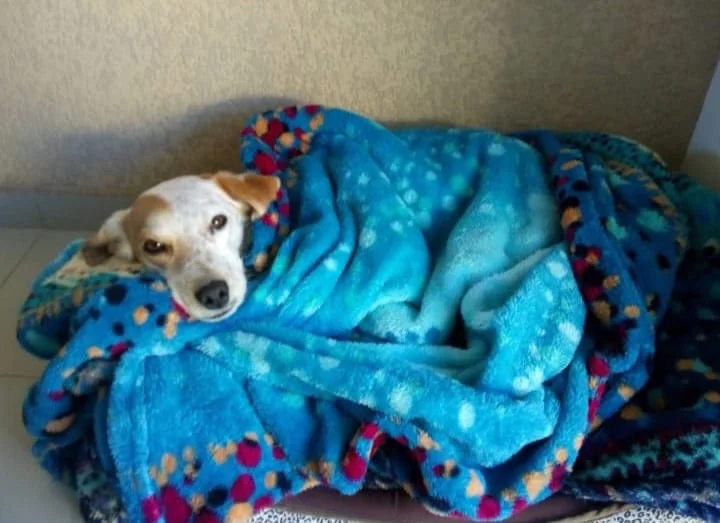
Loli during a resting moment, after a phase of increased bodily sensitivity.
3. Cognitive changes
In more advanced stages of aging, neurological changes may alter how the animal processes stimuli.
Some dogs become more reserved, prefer quieter environments, and show less interest in intense physical interaction. This does not mean lack of bond, but adaptation to their own rhythm.
When a senior dog begins to refuse affection, it is important to evaluate whether there are also:
- Mild disorientation
- Sleep pattern changes
- Alterations in social interaction
In such cases, the issue may be related to cognitive aging.
The most common mistake: interpreting it as “temperament”
A frequent error is attributing the refusal to the dog’s character. Statements such as “he became grumpy” or “she is more unfriendly” oversimplify what may be physiological.
Dogs do not reject affection without reason. They adjust behavior when something in the body changes.
Sensitivity to touch in senior dogs should be seen as a signal for observation, not a personality flaw.
How to differentiate physical discomfort from emotional change?
Some indicators help:
- Does the reaction always occur at the same body point?
- Does the dog maintain interest in interaction but avoid direct contact?
- Is there stiffness when getting up or changing position?
- Is there an overall reduction in mobility?
If refusal is associated with slower movements or altered posture, the probability of physical involvement increases.
If it occurs only in agitated environments, it may relate to overstimulation.
Learn more about this aspect here → https://logicalbark.com/why-does-an-elderly-dog-start-choosing-one-spot-in-the-house-what-i-observed-in-my-dog-who-reached-16-years-of-age/
What to do when a senior dog begins to refuse affection?
Before drawing conclusions, organized observation is essential.
- Identify the region of the body that triggers reaction.
- Assess stiffness when getting up or lying down.
- Observe changes in daily rhythm.
- Seek veterinary guidance to rule out joint pain or inflammation.
The goal is not to anticipate diagnoses but to qualify perception.
Simple adjustments that may help
Some measures reduce discomfort and make touch more pleasant:
- Avoid pressing hips and shoulders.
- Prefer gentle strokes on the thoracic region or neck.
- Keep the environment warm on cold days.
- Provide a soft resting surface.
When the body finds greater comfort, receptivity to affection tends to improve.
The importance of respecting the new rhythm
Aging alters priorities. The dog who once sought constant contact may prefer shorter, gentler interactions.
This does not mean emotional distance. It means physiological adaptation.
When a senior dog begins to refuse affection, the most responsible gesture is to adjust the way contact is offered, not insist on previous intensity.
Conclusion
Refusal of affection in a senior dog is rarely random. In most cases, the body participates in the change.
Joint pain, cutaneous sensitivity, or cognitive alterations are among the main possibilities. Observing before interpreting avoids premature judgments and improves quality of care.
Touch remains a bond — but the way of touching must accompany time.
At Logical Bark, through the experience with our senior dogs, we always respect moments when they become more withdrawn and seek to understand what may be occurring as part of the aging process.
You may also like

Lusiane Costa is a digital writer with degrees in Marketing and English Literature.
Creator of Latido Lógico and Logical Bark, she develops evidence-based content on canine aging, wellness, and senior-dog health.
The project was inspired by Goe — a senior dog whose longevity and resilience shaped a grounded, compassionate view on the challenges of aging in pets.
Each article reflects her commitment to transforming real experiences into accessible knowledge, helping owners understand, prevent, and care better for their animals at every stage of life.
Goe remains the heartbeat of this project.