March 18, 2026

LOLI, whose experience helped expand our understanding of the body of dogs with IBD.
Inflammatory Bowel Disease (IBD) in dogs is usually remembered first for its digestive symptoms. Recurring vomiting, diarrhea, abdominal discomfort, appetite changes, and weight loss are signs that draw the attention of guardians and generally lead to clinical investigation. However, through the follow-up of real cases and the careful observation of how some dogs progress over time, it becomes increasingly evident that IBD is not limited to the intestines. It is a chronic inflammatory condition that can affect different systems of the body, including the joints.
This understanding matters because many secondary signs end up being interpreted in isolation. When a dog has difficulty getting up, shows less willingness to walk, appears stiff upon waking, or feels discomfort while moving, these signs are often attributed only to aging. In some cases, however, what seems to be simple natural wear may actually be related to a broader inflammatory state that begins in the gut.
Joints are fundamental structures for mobility. They connect the bones and allow movements such as walking, running, climbing small steps, lying down, and repositioning the body. For this process to occur comfortably, the body depends on healthy cartilage, an adequate amount of synovial fluid, and supporting tissues capable of reducing friction between bone surfaces. When this balance is compromised, pain, stiffness, and functional limitation arise.
In chronic inflammatory contexts such as IBD, the body may remain in a state of persistent immune activation. The intestine plays a central role in this dynamic because it does not act only in food digestion. It is deeply involved in immune regulation and in maintaining the barrier that separates the body from intestinal contents. When this barrier becomes weakened and inflammation persists, different inflammatory pathways may be continuously activated. This process extends beyond the gastrointestinal tract and may reach distant tissues, including the joints.
This helps explain why some dogs with IBD also begin to show subtle changes in mobility. There will not always be a clearly defined joint diagnosis from the beginning. In many cases, what is observed are discreet signs: the dog avoids certain movements, hesitates before jumping, begins to walk with less fluidity, or shows discomfort in situations that were once ordinary. Rather than appearing as an isolated orthopedic condition, these manifestations may be part of a broader systemic picture.
It was precisely this kind of broader interpretation that LOLI’s experience helped build. Throughout her journey, the signs were not limited to the intestines. There were digestive episodes, bodily changes, and manifestations that, if observed separately, might have seemed disconnected. Over time, however, the recurrence of these signs showed that her body was responding in an integrated way. Intestinal inflammation was not just a localized event; it seemed to influence the balance of other structures in the body.
In LOLI’s case, continuous observation was decisive. Instead of treating each sign as an independent problem, it became necessary to consider that there was a common inflammatory basis sustaining different clinical manifestations. This shift in perspective was important because it made it possible to understand that intestinal care did not serve only to reduce vomiting, diarrhea, or digestive discomfort. Stabilizing the gut also meant reducing the inflammatory burden on the body as a whole.
Read the full article on the subject → https://logicalbark.com/lolis-journey-ibd-in-dogs-and-when-the-gut-skin-and-joints-are-connected/
When we talk about joints, this logic becomes particularly relevant. Systemic inflammation may favor the wear of joint structures, compromise the quality of the synovial environment, and intensify discomforts that might otherwise appear in a milder way. In dogs that already have a predisposition to joint aging, this effect may be even more significant. For this reason, in some contexts, the gut and mobility end up being more closely connected than many imagine.
This relationship does not mean that every dog with IBD will develop arthritis or another joint disorder. It would be incorrect to generalize in that way. The central point is different: in dogs with chronic intestinal inflammation, joint changes deserve closer attention. Guardians and the veterinary team need to consider the possibility that stiffness, reduced mobility, or discomfort while walking may be part of a systemic inflammatory picture, and not only an isolated orthopedic process.
Clinical experience shows that when the gut is better managed, some secondary manifestations also tend to become more controllable. This does not happen by chance. The body functions as an integrated whole. The gut, immune system, skin, behavior, and joints remain in constant dialogue. When one of these axes stays out of balance for a prolonged period, others may also be affected. In this sense, IBD requires a less fragmented and more systemic perspective.
In the follow-up of dogs like LOLI, it becomes evident that quality of life depends on this broader view. Management is not limited to the occasional use of medications or attempts to suppress isolated signs. It involves a carefully adjusted diet, observation of the body’s response patterns, frequent clinical follow-up, and progressive decisions made with discernment. In situations like this, every small change in posture, appetite, mobility, or behavior needs to be read carefully.
This way of caring produces an important lesson for guardians: the canine body does not always separate problems in the same way we classify them. What we label as “intestinal,” “dermatological,” or “articular” may, in practice, be part of the same physiological axis. Chronic inflammation tends to cross anatomical boundaries and produce cascading effects. For this reason, understanding the connection between IBD and the joints is not an interpretive exaggeration; it is a more faithful way of seeing how the body functions.
When looking at LOLI’s journey, this perception becomes even more concrete. Her case helped show that an integrated reading of the body is not a theoretical abstraction, but a real clinical necessity. Observing the intestine as the starting point of broader imbalances made it possible to reorganize the reasoning about the signs that appeared over time. And that change, by itself, already represents an important advance in care.
In dogs with IBD, preserving intestinal health may mean much more than controlling digestive symptoms. It may mean protecting immune stability, reducing systemic inflammation, and, in some cases, also favoring physical comfort and mobility. The joints enter this conversation because they are part of the same organism, subjected to the same inflammatory mediators and the same repercussions of chronic imbalance.
In many clinical management strategies, approaches aimed at intestinal support help strengthen the intestinal barrier and modulate inflammatory processes associated with IBD. Specific nutrients and supplements directed toward digestive health may assist in this process, always under veterinary guidance.
👉 See intestinal support options used in dogs with digestive sensitivity: https://amzn.to/3NwEXqv
👉 Another option well rated by guardians: https://amzn.to/4uCxl6H
In the end, LOLI’s experience leads us to an important conclusion: understanding IBD only as an intestinal disease restricts clinical analysis. In many dogs, it needs to be read as a condition with systemic repercussions. And within this perspective, the joints deserve special attention, especially when the goal is to preserve autonomy, comfort, and quality of life over time.
Disclaimer: This content is for informational and educational purposes only and does not replace veterinary evaluation, diagnosis, or medical guidance. Each dog has specific clinical needs, and digestive, joint, or behavioral symptoms should be investigated by a veterinarian. Any change in diet, management, or the use of supplements and medications must be made under professional guidance.
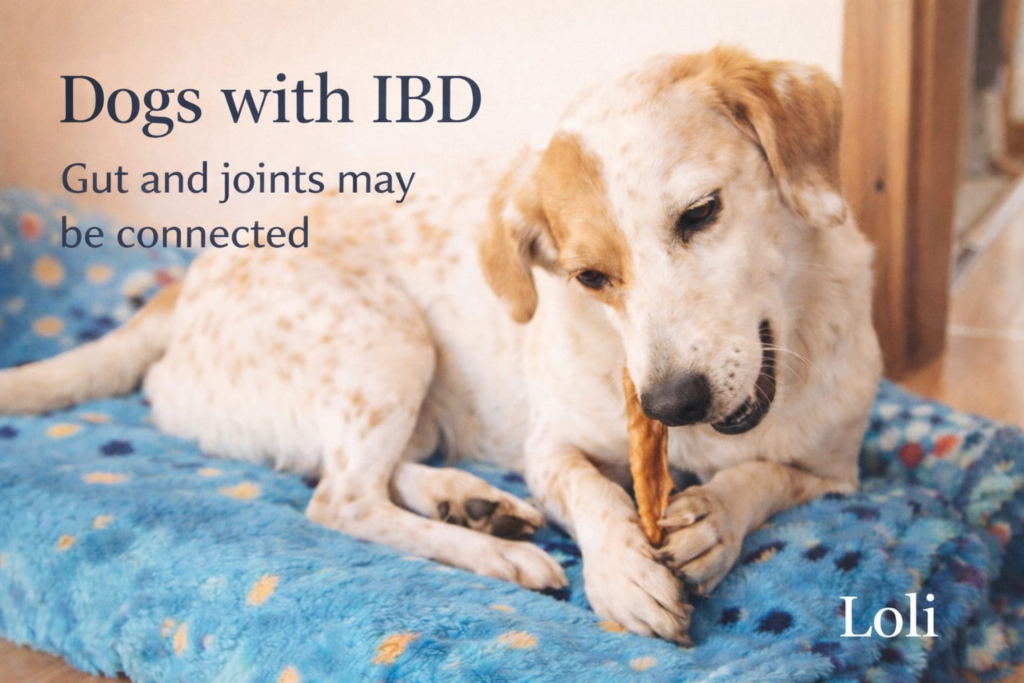
Loli enjoying a moment of rest and natural chewing, important for the well-being of dogs.
You may also like

Lusiane Costa is a digital writer with degrees in Marketing and English Literature.
Creator of Latido Lógico and Logical Bark, she develops evidence-based content on canine aging, wellness, and senior-dog health.
The project was inspired by Goe — a senior dog whose longevity and resilience shaped a grounded, compassionate view on the challenges of aging in pets.
Each article reflects her commitment to transforming real experiences into accessible knowledge, helping owners understand, prevent, and care better for their animals at every stage of life.
Goe remains the heartbeat of this project.